The Fundamentals of Revenue Enablement
Marc: Thanks everybody for joining today. I’m excited. I always get excited when I can share some knowledge and help people along in their sales and service practices.
And as Craig said, I’ve been doing this a long time. I hate to age myself, but it’s been about 38 years, almost forty years, that I’ve been helping organizations with their sales and service processes.
I think it’s important, while I’ve gone deep in many ways in helping organizations implement technology, enablement technology—and we can even talk about what is enablement. For a long time I’ve heard so much, everybody sort of has a different definition and it’s even moved into another space. I mean, fifteen years ago I think the term was invented—sales enablement. And we saw, you know, what fills that role of sales enablement? What technologies fill that role?
The last time I looked, there were something like twenty-two hundred sales enablement technologies on the market. It’s sort of mind-boggling how much is out there. And the question that I try to bring to the table—and the purpose of this webinar—is that
Technology is not a panacea. It doesn’t necessarily solve the problem. It comes down to fundamentals.
Part of what I want to talk about today is what the fundamentals are for finding that hidden revenue.
And it’s not like there’s stuff just hanging out. It’s more about how our organizations operate. I’m sure some of you are already doing many of the things I’ll talk about, but a lot of organizations I talk to just aren’t in tune with what it takes to really enable their sales and service. And that includes pre-sales. The whole pipeline, depending on the size of the organization, really moves from business or sales development to account executives. And the sale isn’t even completed even from that standpoint until you get to services.
Revenue enablement actually goes upstream from there. There’s a lot of money that you as an organization spend on even supporting your brand and creating qualified leads or suspects that go into a sales development representative or directly to an account executive.
The problem that this has become is that revenue enablement focuses on how to optimize that cross-functional. Even if it’s just one or two people in the organization, it’s about making sure everything moves along appropriately.
What technology has done is put us to the point where sales moves at the speed of light—or maybe even faster than light if there’s something faster than that, to make a sale. The opportunity to misstep – to not respond quickly enough, or not have the right approach, or to misunderstand the situation – can really put you at a disadvantage.
Because even now customers or prospects, they’re not always very patient, you know, depending on what you bring to the table. And they expect that the process they go through is part of your value.
Because so much of what we do is getting commoditized on a rapid basis, including technology. I mean, Craig and I were talking about this the other day. It’s like every unemployed programmer here and across the world suddenly has a piece of technology that they’d be interested in selling.
The Real Stakes of Revenue Enablement
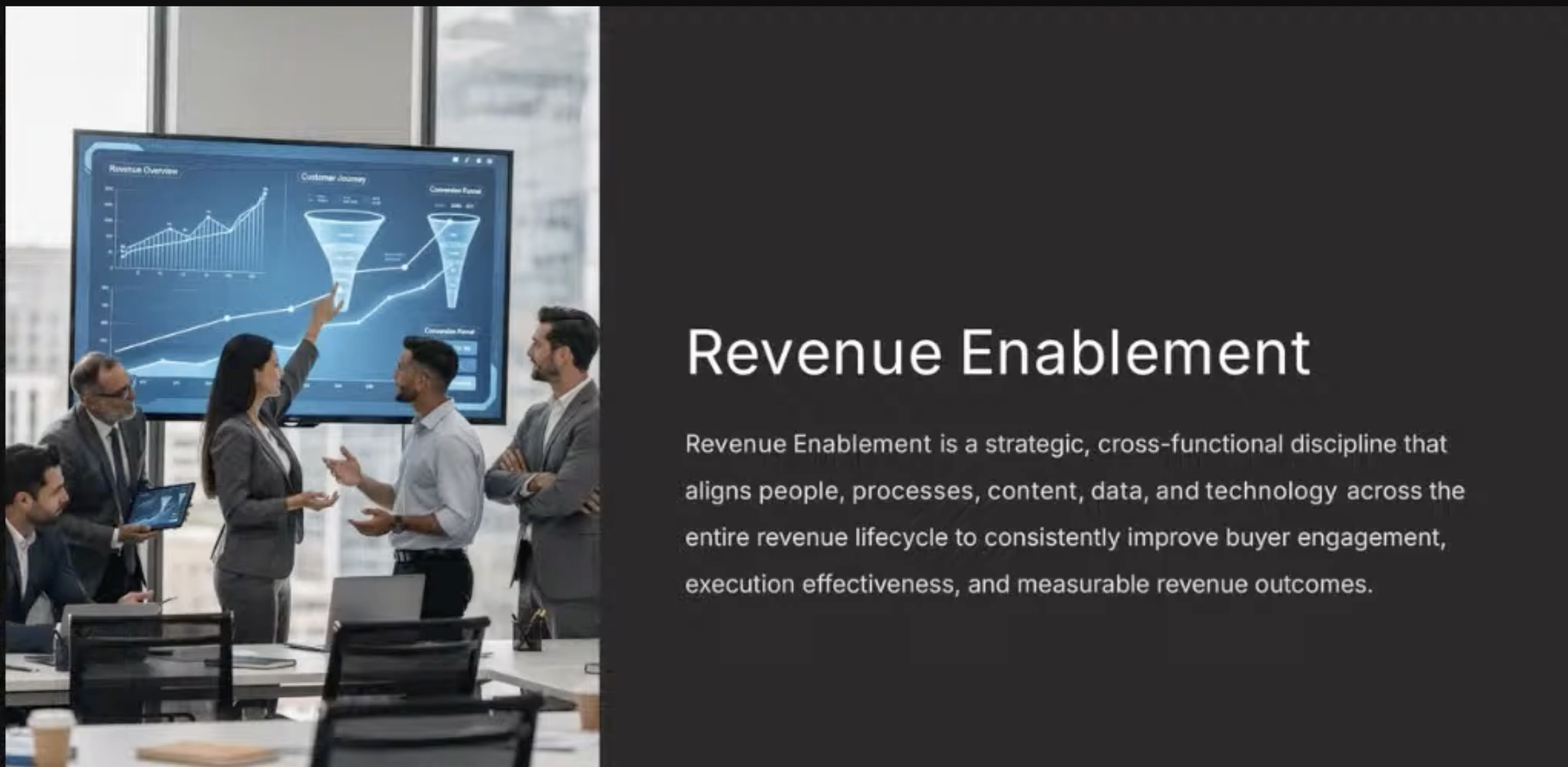
Marc: So you can see the definition of revenue enablement. And I think for some companies it’s bigger than others, but what it’s really about is making a distinction in terms of the customer point of view and the salesperson’s point of view.
But the stakes are so real, they really hit, and they hit hard. I’ve got stories and can tell you stories.
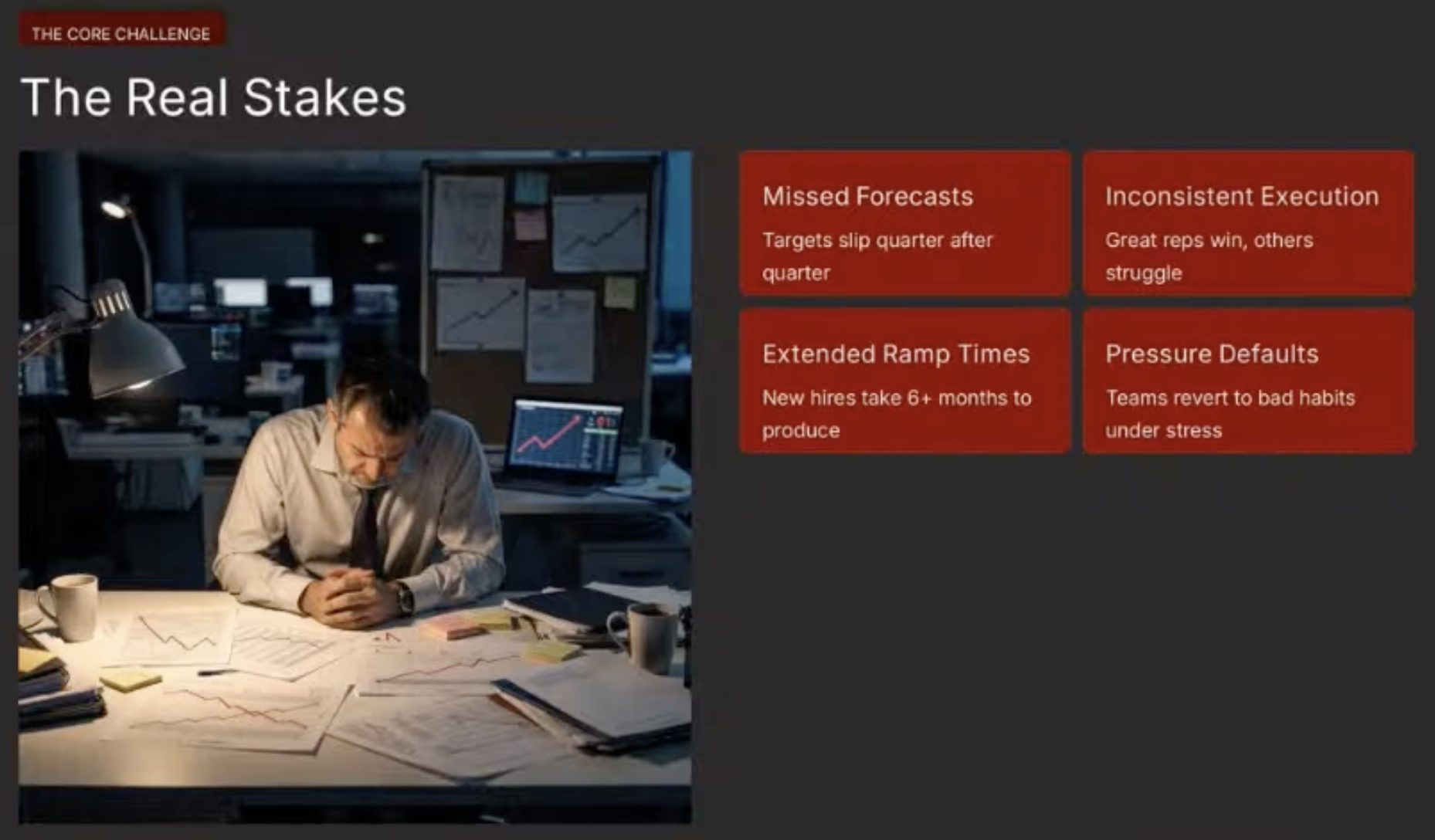
Missed Forcasts
The first one I can tell you about is Missed Forecasts. I was doing some consulting for a medical consulting firm and they were recruiting people out of the medical industry. These were doctors that they were recruiting to be account executives. And in the first year that I worked with them, they missed their call. By call, I mean their forecast on three quarters. And the problem was they were bringing these salespeople in very rapidly, and they didn’t consider, even though they were mature and were buyers at some level, that they knew how to develop a forecast and what a forecast meant. There was a whole onboarding and training issue there.
I won’t tell you the name of the company, but the first quarter I was involved with them, they missed a forecast by 80 percent. I can tell you that the CFO was not very happy. You don’t run a business when you can’t hit your call and heads roll.
Inconsistent Execution
I think the other thing and many people see this particularly in smaller companies is inconsistent execution. And we all know, and you’ve probably heard the dilemma, the larger the sales force that you have, you’ve got different levels of capability.
You have some people who are more mature, so they might be A’s and B’s, and then you grade them down to C’s and D’s. And those that are A’s don’t necessarily transfer those skills and that knowledge to others. And there’s a missed opportunity there to capture that.
One quick story I’ll tell you is that I did a big, big consulting gig with a very large computer firm of two initials. I won’t tell you who they are, but they built a repository. They got all their A players to record something we had them call Ring the Bell. And Ring the Bell was just a knowledge capture feature. And in those days we had to use a telephone and you had to submit some slides and use the telephone and narrate the slides and answer six questions. It was the most popular content in their sales repository compared to any other piece of content. And that’s just knowledge sharing. And it helped in shaping the execution.
Ramp times
If you’re a chief sales officer or head of sales, whatever your title is, you want to get people productive really, really fast. But it’s a challenge, particularly in a smaller organization, to make that happen.
And often, as the quotation is there, the average time when we survey CSO’s is six to nine months to see some base productivity. And we don’t have to do that anymore. There are ways to make people more productive with what we have in our hands. And it isn’t necessarily technology. It’s back to that concept of knowledge. And how do you foster knowledge and coach?
I mean, when I started in the field, I worked with a lot of people who had cut their teeth with Xerox. And the reason I mentioned Xerox is they had one of the best sales training programs in the industry back in the day.
Craig’s shaking his head yes, because you couldn’t even go out and sell anything on your own until you were mentored by at least one, if not two salespeople and you ghosted them on every call that they did for up to a year. I’ll tell you it was a great learning experience because it was like infusion you know, it was amazing and it was a metamorphosis.
Pressure Defaults
The last and this is very very common: even though you might know what to do pressure defaults it’s a great great thing to understand is that when people are pressured to meet quota, they feel they feel a lot of pressure. And I’ve seen a lot of sales managers, they’re not necessarily coaches. We used to call them spreadsheet jockeys because all they cared about and all they did with their teams was to say, what are you closing this month? What’s going to close this month? Instead of asking the question, what are the obstacles and how can I help you close business? Those are two different questions to ask.
And those pressures really can hurt an organization, particularly on younger, less experienced salespeople. And those people are coming up in the world. And in fact, sales isn’t always seen as something that even though it’s very lucrative for people that they want to go into because they feel that pressure. They absolutely feel that pressure.
From Training to True Sales Competency
Marc: So the other thing that I see a lot of when I talk to organizations is they think that they’ve got it all done in terms of enablement.
We brought them in. We gave them death by PowerPoint. So they’re trained. You know, you understand the basics about the product. You understand, you know, our sales process. Okay, it doesn’t matter that once you walk out the door from that two days of training or one week of training, you’ve forgotten 80 percent of it.
So training in the world of real trainers is: you’ve hit competence. Competence takes a long time to achieve. It doesn’t happen in a week. And there’s ways to work on that.
We’ve got the content. It exists. It’s stored somewhere. However, you know, I’ve been involved in creating big, big repositories. Organized really well. But nobody really uses it. It’s either too hard to find or it’s just not being made a habit. It’s not being promoted. It’s not being, in a good word, internally marketed.
I’ve actually worked for one company where everything was the inbox. And there wasn’t a lot of activity in the case of somebody saying, hey, let me bring you to this. Let me show you it. Do you understand what it means? Do you understand how to use it?
It was typically: here it is, it’s labeled really well, go at it.
The other one that’s really good, and while we have this great tool, no insult to SalesNexus, it’s a great platform and it’s getting better every day, it’s in the CRM. But again, there are circumstances where the CRM is a great tool for prepare, but it isn’t necessarily a great tool in the moment. It comes down to competency and pressure. I can’t go into the CRM it’ll take me too long to get that information right or we make assumptions about people. I hired this person because they know it well that’s a bad assumption too right we all are in a position that we’re put into new situations or we’re pivoting on something it doesn’t mean we know the best way to pivot or respond or move forward in a way that’s going to make us a trusted advisor to the customer.
So it’s not that there’s a lack of information. Everybody creates volumes of stuff, but the problem is context, clarity, and confidence.
If you haven’t used something or you haven’t developed that muscle memory, you may not be apt to want to go forward with that.
A Lost Deal: The Real Cost of Enablement Gaps
We’ve all seen lost deals.
And we’ve all experienced something. I recently had one that, I don’t know that if I had the data, I could have pivoted. Well, I probably could have, now that I reflect on it. And I lost a multimillion dollar deal because I didn’t anticipate a market condition that came upon us. I probably could have dealt with it sooner.
And I’ll be frank with you all, it was tariffs. It was tariffs.
And the issue was we had bundled this offering in a way that was very expensive for a five-year engagement. And had I thought about it sooner and communicated to the channel that I was working with, it wasn’t my direct deal, I would have counseled them to break it apart into smaller invoices.
And instead, the size of the invoice scared the CFO and he wouldn’t sign off on it. Had it been smaller, it would have felt less risky. And I think we would have gotten through that.
So it was something that, you know, outside influence people thinking about things differently experience, it takes you to a different place. And those things are critical and are real issues in regards to, how you move through something and anticipate.
And I think what’s interesting is that Nexi and other AI is starting to help with that, but it’s only as good as the way you manage it. You have to think of those things first. You have to categorize that information first and get it on paper.
Craig: Darren’s asking a good question that I think is relevant to what you’re talking about. When you have a buyer in a new industry… maybe it’s a new industry that your company hasn’t traditionally done business with or just a new industry to you as the sales rep. Or you don’t have a lot of familiarity. That’s a great example of where you just your slide kind of touches on the salesperson may just kind of get stuck and not know how to respond to questions, appropriate answers, blah, blah, blah, right?
Marc: That’s a great point. And it’s where we’ve done a lot of work with companies in that I think, Darren, what’s really important is that particularly the salesperson or the account exec may not have encountered that industry, but there’s also an opportunity to go upstream with your product management. Those who own the product to look at, okay, the what ifs. And again, prepare for those because all your value propositions that you bring and start to look at, and I’m sure Darren, you’ve thought of, you know, the persona of the industries of your ideal customer profile and where you’re most valuable, but those elements can certainly play in other industries.
And relative to Nexi, what’s interesting, once you have those plays feeding something like AI, and maybe you haven’t thought of an industry or it’s a new industry, okay, AI is going to go, “Oh, you already got this information. Just use it differently.”
So then in that case, you can say, oh, we’ve never encountered, you know, swimming pool manufacturers. Boom, what would we say differently? Or how would we, what value propositions have we already mapped or key messages or insights that could be crafted in relation to that?
Does that make sense, Craig.
Craig: It does, yeah. And just to kind of dig a little bit deeper on that. To me, I’m kind of playing catch up here with you. You and I met a few months ago and I’ve learned a tremendous amount from you.
But when we and I met, when you and I met, in my mind, sales training, sales enablement, I wasn’t really clear what the difference was.
You’ve kind of started to shed some light on that just here today. But again, the slide you have up right here, to me, that’s the real practical example of what actually happens in the real world. It doesn’t matter if you’re talking about a seasoned expert, long time industry hand, or a brand new guy straight off the bus, so to speak.
Either way, they sometimes just get stuck. They don’t have the right answer you know the standard you know what sales trainers will teach you is when you don’t have the answer you say well you know that’s a great question i don’t know the answer right now but I will find out . A And so the salesperson writes that down and they’re gonna go, that’s a follow-up action. But that’s where things fall apart it may not be that easy for the salesperson to get the answer. So that that friction makes it less likely they’ll follow through and in the meantime as your slide points out the buyers just kind of “Hey, I’m moving on.” I want to deal with somebody who knows how to answer my question now.
And in today’s world, that bar is only getting higher because people expect you to be relying on AI to answer their questions instantly.
You’ve got to be able to say, hey, new industry, put it all together. Tell me how to respond to this question.
Marc: Yeah. And there’s a process to that. That’s, really important. I’ll tell you a quick story.
It was ten years ago, I launched my company, the company that I founded, The enablement group with Extreme Networks. And networking is a crowded space, for sure.
But we worked very long and hard with the product managers because the way we overcame that, there was no AI in those days, but what we did was we used a chat function, which we built for them. But the idea was there was a deal support desk. Meaning if I was a rep and I’m on a call, I’m talking to a customer or I have to email them back. Boom, I hit a button. It’s right there, pops up out of Salesforce, wherever I’m doing my business. I say that because it was Salesforce with Extreme.
The thing that happened was that desk was manned, populated by a product expert. And what would happen is they could have a dialogue back and forth instantly. And that product expert either would go into a library and hand them information or say, give me three minutes and would type or give them a dialogue to come back with.
And it worked.
That was part we did a whole thing of enablement we had a lot more to it, but we did that for their channel which exploded because the channel was the least informed about their products and services and that’s where they were getting the majority of their business. So they put all these support mechanisms.
And you know to your point Craig enablement is nothing more than, in my opinion, knowledge management. And it starts with a training function, right? And it looks at what do you have to have as outcomes, and we’re gonna talk about outcomes here in a minute, and how do you make that all happen.
Where Revenue Actually Leaks
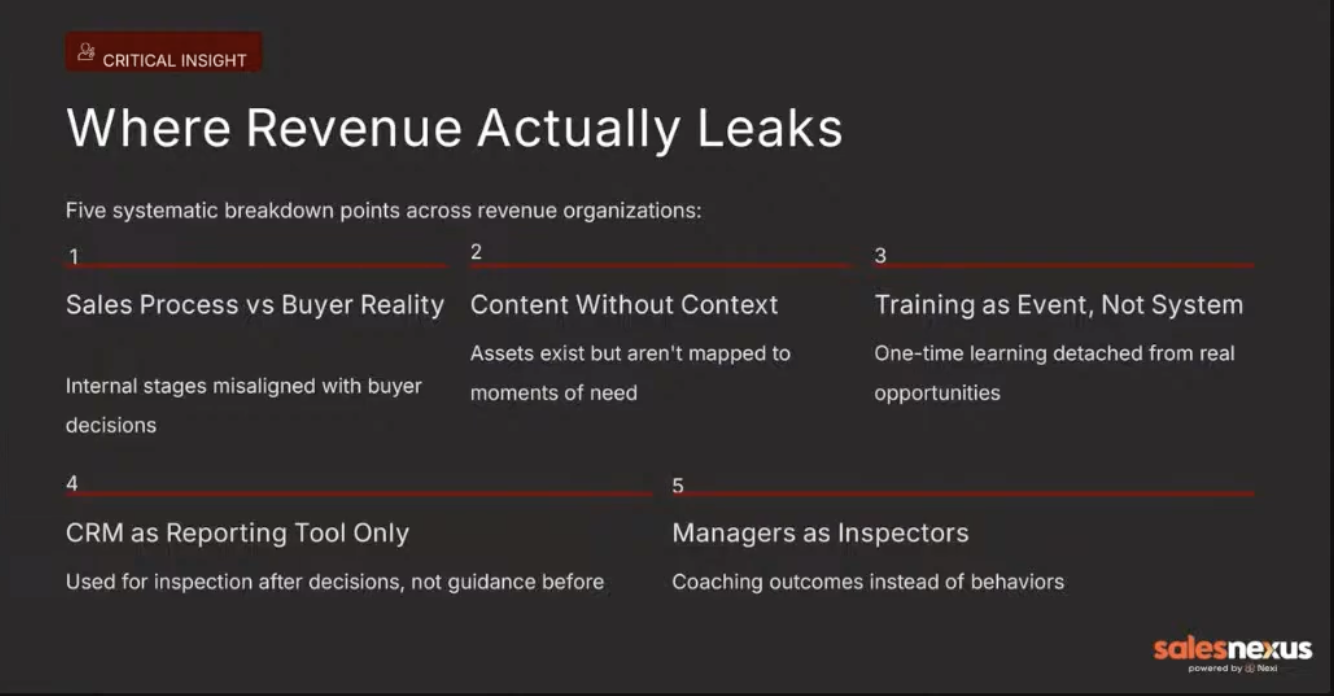
Marc: I think there’s some mistakes. Some will recognize these. But there’s five major sort of things to be critical about in your organization to prevent the leaks.
Sales Process vs. Buyer Reality
Again, I’ve been at this a long time. And when I started doing sales training it was all about sales process. Everybody’s heard about value value selling and Aslan, and you can name them all right I mean there’s dozens of them out there and they were all focused on process, process, process.
But what’s happened is that as technologies come into play and things that occurred, when we really got sophisticated with marketing automation and websites, and now with AI to boot, I mean, you have a prospect. Sometimes they know more about the company than the salesperson knows.
I mean, when I’m buying now, I just go deep. And one of the ways I associated myself with you when we met, Craig, was I went deep. I tried to gather as much information about you before I even reached out. So that happens a lot.
Craig: So that’s kind of the landscape that you’re describing now going forward is that we should kind of assume that the customer is going to be more informed than the sales rep. And the sales rep is not even trying to be a sales engineer. They’re more of a facilitator of getting the right information for the right situation.
Marc: Correct. And the thing where it says buyer reality, what a buyer wants is a trusted advisor.
And a quick story, I have turned prospects away who have come back to me later because I said, you don’t need me. You don’t need me. No hard sell.
Understand the customer and their journey. Where are they? What are they thinking about? Instead of your sales process. Yes, sales process is important for developing and keeping your forecast, but that’s not how buyers or prospects buy.
And when you’re building plays or you’re thinking about what the customer wants, you’ve got to deal with that.
I mean, the first thing a prospect wants is to be pitched. Don’t pitch me. We often forget that. I mean, I used to counsel sales development reps and their approach was, “Hi, I got you on the phone. You want a demo?”
I don’t want a demo. I want to understand whether what you have can help me or whether you understand what my problem is. Do you even understand what I’m trying to solve? So your questioning strategy and when you deliver information is extremely important. And there needs to be some focus on that.
Content without Context
I think the second thing, and we all suffer from this, is content without context.
I’ve seen marketing work on so much material, but not create the context on when and why and where to use it. So there’s a library, but what do I do with this?
And let’s be real. I’m a salesman as much as anybody, but salespeople are so pressed for time. Don’t expect them to necessarily read the content you want them to use, particularly if it’s new. They’re under so much pressure, particularly white papers and position papers. They’re not necessarily going to absorb that. So the more you can do in terms of a synopsis, or giving them the contextual approach.
And again, this is where used correctly, AI can help. It’s your knowledge, it’s your material, how you create context to the salesperson so that they don’t lose opportunity is really, really important.
Craig: Yeah, I think there’s like two elements of that that we’re working on anyway, and it’s a work in progress, it’s not perfect yet.
But one is just, if things stall in my pipeline, then make sure alerts are happening and new things are happening and just nothing goes cold and just stops. So that’s number one.
But the number two, that’s where the AI comes in is where, you have a call with a customer, it’s transcribed, whether it’s a meeting or an actual phone call, whatever, automatically. And now the AI has the context of that conversation.
And all of those questions that the customer asked, the AI can then recommend. “Hey, you might want to follow up with this piece or that piece or clarify your answer to this question or whatever.” And even in our initial use here in the last two or three months, it does pretty well with that.
So it’s all about having that library put together and sort of tabulated the way that you’ve talked about when you and I’ve spoken about what you guys do. That is really the foundation of all this.
Training as an Event
Marc: Indeed. And if you look at one and two, and the work that has to do with that. So to your point, Craig, you have to create the context. You have to teach the AI if you’re going to use it. Why should I understand this? And that’s part of your play.
If you look at three, four, three and four, these are really, in my opinion, huge problems today, given the pressures. The days of Xerox and mentorship and all of that are gone and nobody has that time anymore, right?
And most organizations, as I was stating earlier, they look at training as an event.
Training is systematic today. It’s not an event.
People learn with continuous reinforcement and coaching at the time that they need it.
I have a problem, how do I solve it? Oh, I learned that or it was taught to me in the classroom. God help me, I couldn’t remember that if I had to, right? So how do you instill that into their everyday responsibilities? How do you instill that into their flow of work?
CRM as a Reporting Tool Only
Marc: And that goes to number four. And it’s the thing that you and I have been talking about, Craig, is that a lot of organizations look at CRM as a reporting tool only. Management wants to know what’s coming down the pipe, but it can be so much more when you think about it correctly.
It’s often used for making decisions about how well somebody did rather than necessarily guiding them with an opportunity to do better.
And that’s the promise of what you got going with Nexi.
But again, I want to warn people, it’s not automatic.
You don’t just let it reach out on the internet and figure it out for you. You’ve got to teach it. You’ve got to counsel it. You’ve got to implement it correctly.
Craig: No, you’re absolutely right. We’ve seen that.
Now that we have clients really going live and migrating their existing CRM into the system, just that, even though they were doing it in a different system and so the data is a little organized differently, they put it in to our new system with Nexi and it sees all of that history of years and years and notes and proposals and sales opportunities and stuff – and just instantly the answers and recommendations it’s giving the sales rep are just a million times better.
Marc: Yeah, and this stuff is going to mature. It’s going to mature pretty rapidly.
And my goal in collaborating with you and collaborating with companies is to make sure that they use it well. Because there’s going to be a lot of pitfalls. People, I don’t think, necessarily understand all of that. And I don’t want to get into a technological discussion. So it’s a facilitator and a reinforcement tool and a guidance tool for the sales reps.
Managers as Inspectors
And then when I was talking earlier about spreadsheet jockeys is to get managers out of the role of inspectors or abusers. I’ve seen that happen. And teach them proactively how to be better coaches.
And it isn’t always natural. I mean, one of the things about sales managers is that they’re often promoted into sales management roles because they’ve been good salespeople. But it doesn’t necessarily make them good trainers or coaches.So how can the system reinforce that and give them tools and guidance because the human factor is still important.
AI is not the end of everything, the end job. We still need people to be leaders and coaches and trainers and mentors. And that’s an important distinction.
And the AI will help those people as well, where it’s just not a natural capability for them.
Leakage Point 1: When Process Meets Reality
Marc: We talked about when process meets reality these are kind of the details I’ve already gone through on that single slide and this will help you reference back because we’re going to distribute the slides are we not Craig at the end of the presentation.
Craig: Yes sir. Yeah we’ll be sending out the recording and all that good stuff.
Find the slides from the webinar here: Rev Ops – SN Webinar
Marc: As you look at this, there’s some scorecard issues here, right, which come in these little notations.
Find the Revenue Readiness Scorecard here: Find the Revenue Hiding in Your Pipeline
So the question is, do you believe your reps clearly articulate the buyer decision at each stage? Do they know that as opposed to their sales process?
So what are your stages of the buyer journey? Have they been laid out and do the reps understand what the buyer’s decision or question is? It can be a question when they’re in that part of the journey.
And journey mapping is important. And for transactional sales, it’s a little easier. For very complex and high value sales, it can be a lot harder.
Craig: Can you go a little deeper on what you mean by the buyer journey? Because what I see is most people aren’t really even thinking about it as a buyer decision. It’s more, you know, we did the demo, so that means we’re moving to the next step. So it’s about my behavior, not the buyer’s behavior.
Marc: Well, here’s an example. And I know it’s a little small.
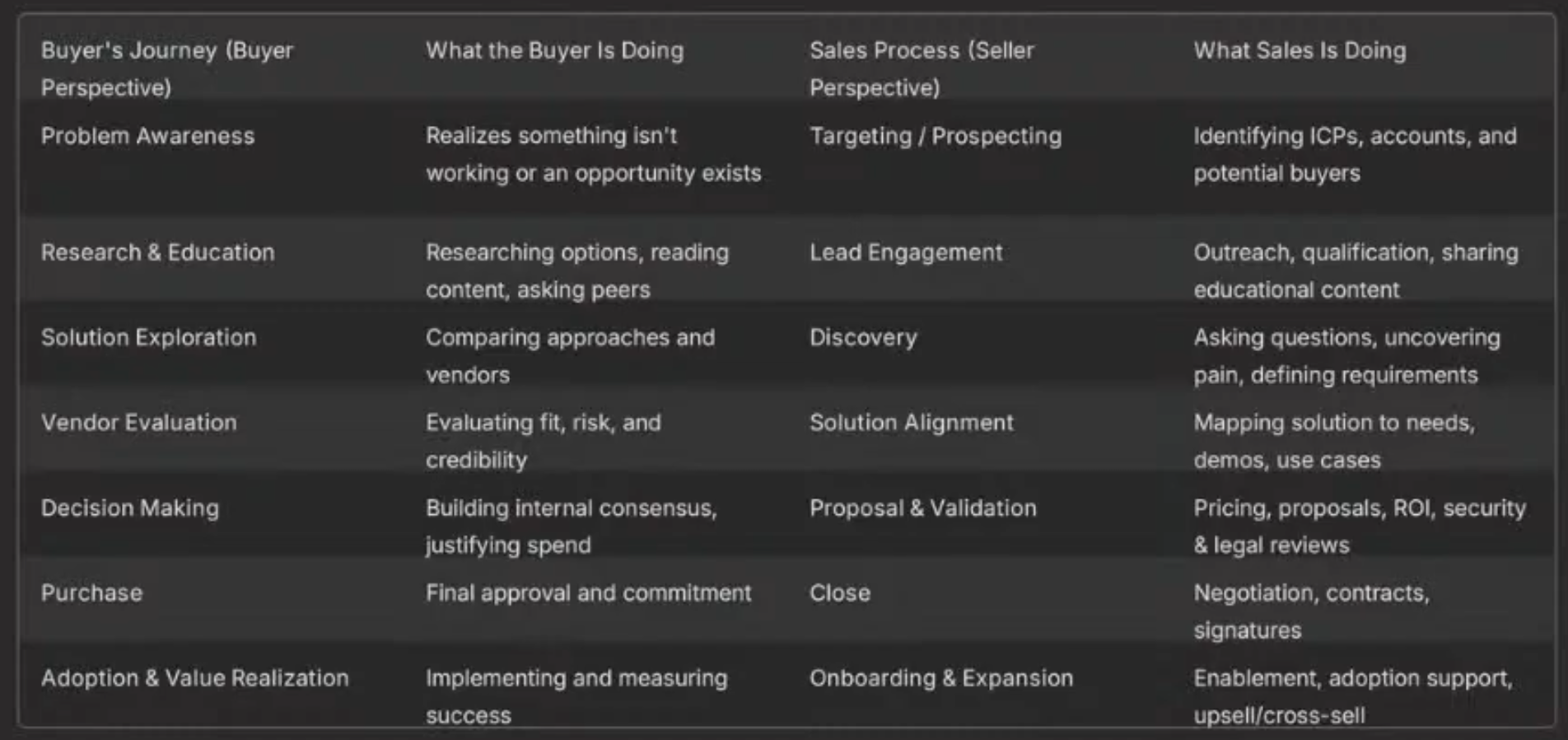
So the question is, do you believe your reps clearly articulate the buyer decision at each stage? Do they know that as opposed to their sales process?
So what are your stages of the buyer journey? Have they been laid out and do the reps understand what the buyer’s decision or question is? It can be a question when they’re in that part of the journey.
And journey mapping is important. And for transactional sales, it’s a little easier. For very complex and high value sales, it can be a lot harder.
Craig: Can you go a little deeper on what you mean by the buyer journey? Because what I see is most people aren’t really even thinking about it as a buyer decision. It’s more, you know, we did the demo, so that means we’re moving to the next step. So it’s about my behavior, not the buyer’s behavior.
Marc: Well, here’s an example. And I know it’s a little small.
You can see it typically. And this is not a perfect map. It’s an example map.
The buyer needs to know that they have a problem. In a lot of organizations were the hammer looking for a nail. Well, that nail doesn’t necessarily know it’s a nail.
Craig: So just because I’m a family of four and I live in a certain neighborhood and have a certain income, that may make me appear to be a prospect to buy this new condo that I’m building or finishing. That doesn’t mean I’m looking to buy a condo.
Marc: Well, and one good example is in Pfizer and insurance these days, compliance is huge, compliance. And many, many organizations as they get into things, public companies especially, don’t realize the compliance issues they have and the attorneys don’t even necessarily keep up. So if you had a product that would help them with compliance because some state regulation has changed or it’s constantly changing or in healthcare, HIPAA and all the things that go with staying in line with the law. That’s one where you can easily call an executive and they don’t even realize they have a problem like that.
Related back to AI, we were talking about this yesterday, all these AI companies and people buying AI, there’s a whole level of legal issues now when you put it to use in terms of liability. So attorneys are going out there and saying, hey, I don’t think you realize that instituting AI has some issues with it, depending on what industry you’re in and how you’re using it. So there’s another example.
And a lot of these before were upstream. Meaning marketing was handling this. But in a lot of smaller companies and even where the way that we’re prospecting today, a lot of it’s driven down to the salesperson. So you may have to help them rather than just targeting them in a process. Make them aware of the problem. That’s where SDRs don’t necessarily work well.
When we built playbooks, it’s like, “Hey, show them that they have a problem.” Talk about it. Don’t ask for the demo. Educate them if they don’t understand. And then bring them into exploring the solution.
With a lot of software, that’s a free trial. But free trials are troublesome because people sign up and they don’t do much with it. So you’ve got to have guidance – what are my outcomes? Why should I look at this? What does it do for me that somebody else doesn’t do for me, right? And you would look at that as discovery.
Evaluating. Multiple vendors. What’s the competition? Don’t diss the competition. You know that from play, but compare and contrast. And what do you have that you feel puts you in a better position to do business with me as opposed to somebody else? Not just because you’re cheaper and discounting is a bad move. We know that, right? So how do you do that?
And then how do you facilitate decision-making? This often is one where I see people losing deals a lot in that they don’t understand how the company would make a decision; particularly if it’s by committee or you’ve got five executives who have to sign off on this proposal.
We’re in this process, we’re in the stage of the process, but what does it really mean in terms of their journey? Do they need ratification? Is purchasing involved? Is legal involved? All the things that go there, what’s the checklist for them? And how do they facilitate that for you so that you facilitate it well with your company and make it work for them.
And then they make a purchase. Doesn’t mean in my book that they’re a customer.That’s when they get handed over to your adoption team or your customer service team and that you seal the deal, particularly where so much these days is renewals. You want to create a raving fan. So, yeah, onboarding. But what does that mean to them? What’s the milestone for them that they realize that value? And in their journey, you can get a testimonial from them that they say, you’re the best thing since sliced bread, rather than this is more transactional and it’s simplified. This is more value-based and customer-centric.
So that’s just an example. And we can go deeper or have discussions more about that than just this one slide.
Marc: Was that helpful, Craig?
Craig: Yeah, no, that’s great.
As you’re going through all of these, I’m sitting here thinking about my Sandler training days back when I had my sales team going through Sandler training. And at every one of these steps, there’s kind of what those guys used to call the takeaway.
Where if you’re at that problem awareness stage, you can show up and say, “Hey, we’ve got a better widget that’s less expensive, higher quality, lasts longer, blah, blah, blah.” All these benefits. But what salespeople struggle to do, we all do, sometimes it feels awkward. But the thing that’s hard to teach salespeople to do is ask the customer: Is that a problem that you’re trying to solve right now?
Or what the Sandler guys would always say is: have you given up trying to fix that? Or is it just not a priority now? Sometimes that’s the case.
Marc: There’s even—you can go in front of this to say, how do you even earn the right to ask the question?
We see that as an early problem. How many phone calls go unanswered? How many emails get thrown in the trash?
Craig: But just to bring this back to enabling the salesperson.
Obviously, we want to teach them to be better at qualifying and not pushing their opportunity through a pipeline artificially. But what we want the technology to do is to make it easy for the sales rep when they recognize that. Like I just asked that question and clearly this is not on this customer’s list of things to do this quarter or this year or whatever.
It doesn’t mean that’s not a prospect. It might be a prospect next year, next budget cycle, next season, whatever. But the salesperson’s attitude is: I have the opportunity right now. I’m going to double down and try to close them no matter what and hope I get lucky.
Partially because they know what they invested to get to that point, and they feel like that’s all going to be wasted. But I think also because they know themselves and their systems are not perfect. We’re all human. And even though that customer may be saying, look, our budget comes up again in January. So let’s talk in late January or early February and things may have changed.
The sales guy knows, I’m probably not even going to remember your name by then.
So what does he have to lose to just go for the close right there?
If the organization is able to establish a process where the sales rep has confidence that even if he, as a human, forgets who that prospect was, when February rolls around the system is going to say, “Hey, remember this guy? You should probably call him now.”
Then it changes their behavior a lot.
Marc: Yeah, there’s a lot buried in there too. This is the whole concept of sunk cost. Knowing when no is a no. Too many salespeople put a long tail on something. You got better things to do. So it goes in both directions.
But you’re right. Coming back to it at the appropriate time. I’ve got great examples where it took two years to have somebody. But you wait and don’t force it. People appreciate that.
Craig: It depends on the business. If you’re selling used cars, I get it. You walk off the lot, they’re not coming back.
But if you’re in a business-to-business situation where these companies are going to be your clients for a long long time, the last thing you want is to be encouraging your salespeople to treat them that way.
Marc: Exactly.
Leakage Points 2 & 3: Content and Training Gaps
Content and training gaps are huge leakage points.
My theme, and I’ve said this and I’ve done another webinar and presentations on it, the key is knowledge.
Systems are great, but without knowledge, without using the knowledge effectively and reaching competency, nothing improves.
And there are so many surveys. I don’t know if people remember CSO Insights. Now we have the Revenue Enablement Society and we’ve got Sales Manager Society. They all point to the process of bringing people to learn and instill the knowledge into people to be able to make things happen.
And the machine’s not a replacement for that. The machine is a facilitator of that.
And if we keep that in mind, you can do great things. Systems and leadership are very important.
I think this is where our collaboration, Craig, really works well.
CRM is not just a reporting tool. It’s a facilitator of so much more. And I think that’s the future.
You’ve done a great job in bringing that into SalesNexus, and I think it’s only going to get better.
The historical information will help with prediction and doing the knowledge management and using it appropriately so that there’s knowledge and training at the point of need when you need it, and content.
And then having managers facilitating a change in behavior there. I don’t want to say every manager is a bad manager, but we’ve seen it rampant in the sales industry because they’re not trained to be coaches. And they’re getting pressure. The chief revenue officer is saying, “What’s closing?” And you’re all driven by revenue. It’s the lifeblood of the company. So there’s a lot of pressure to get it done.
I think if we can help people step back and be facilitators of the entire process, you’ll see deals close faster. Your velocity increases, your discounting goes down, and you’ll see improvement and more productivity from your people. More people will hit quota as a result.
And if anybody’s interested, I have a position paper on when you do this and how it breaks out in a company. It’s about twelve years of data to show that this stuff really works.
Craig: Well, real quick on that, Mark.
One of the things that I hear about the most is the deal goes cold. The customer goes dark or whatever. They just stop. And that’s something you’ve touched on in a number of different ways.
But at the end of the day, sometimes it’s not that the sales rep didn’t have the right content or anything. They’re doing a great job in their conversation with the prospect. They’re setting upfront contracts at the end of every meeting and all of that.
And then the guy just disappears.
And my question is, you brought up your paper—how big a portion of the revenue leakage or drift that you see is that one specific issue?
Marc: You mean the knowledge transfer?
Craig: No. Deals that stall.
Marc: I haven’t seen a deal in some way, shape, or form not stall.
Let’s put it that way.
Because at some point, on average, there’s something that gets in the way. And I don’t mean it’s the salesperson’s fault. But maybe they didn’t answer immediately when they had a group of people on a call, or they had engagement, then it moves. We can’t meet with you now for another ten days. That’s a stall. That’s a stall when you’ve got one week left in the month.
Craig: Or it’s, my CEO has decided to go on vacation for the next ten days.
Marc: Exactly. I don’t mean to be facetious, but it’s just the nature of the thing. You can’t prevent all of it, but you can improve a lot of it. If you deal with it correctly.
And the most egregious stalls, as I’ve pointed out here, are lack of knowledge or content, contextually based content that’s going to answer questions and prepare you to ask the right questions.
How many people have seen the suffrage of happy ears? I call it happy ears. “Oh, I closed the deal!” Did you? Why do you say that? Well, he said he’s going to buy it. That’s not a close. You had a lot of work to do.
And that was the problem with the first scenario I gave you. All these doctors heard positively that what they had was valuable and they took that to be a close. But they had ten more steps in their selling process and the buyer’s journey to get to a close. In some cases, it was six months out as opposed to that quarter.
So, that’s where your revenue leaks happen—in that timeframe.
To be more productive requires having the right things at your disposal and the right knowledge.
You can’t prevent it all, but you’re going to do a lot better job.
What High-Performing Teams Do Differently
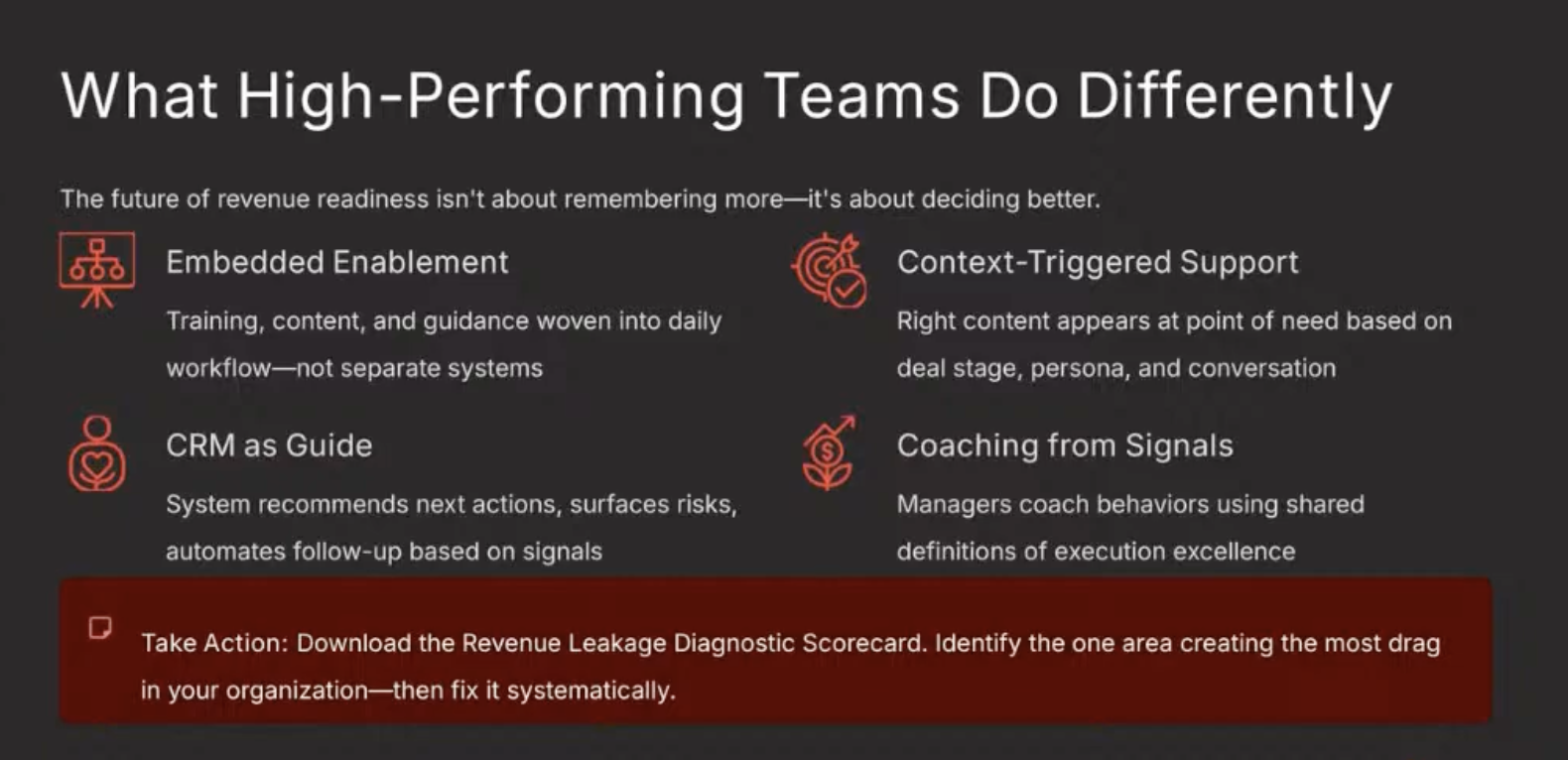
One of the things I appreciate—and this is a little log rolling—is SalesNexus and its elegance, particularly what you’re doing now in the total package, is really critical.
The sales stack, many salespeople say, “Oh stop. How many things are you going to make me log into?” How many things do you think are going to solve this problem and that problem? And it gets so complicated.
There’s a great chart that shows that with all the administrative tasks at hand, salespeople only have about 28% of their total time to sell.
All the other time is dealing with technology and administrivia.
Craig: You mentioned Xerox before. What I remember is a guy that I met early in my career. By that time, Xerox was already kind of legend and at the end of their great reign as one of the elite sales organizations.
But this guy had worked at Xerox, and he had this binder that was their sales playbook. And what was so awesome about it is it was all tabulated. You could look at those tabs as a salesperson and every situation that you were commonly going to run into with your customers, there was a tab for it. You just flipped it over and there was a letter that you could send the prospect that addressed that particular question, issue, or objection.mAnd there was some kind of cost analysis and all the resources you needed for that specific issue the customer was bringing up.
What people have replaced that with is this: All the marketing content is over here. You put all your sales customer information over here in the CRM. And then you’ve got the product information over here.
And it’s the salesperson’s job to figure out where to go at what time and then collate it all together and put it into some kind of communication to the customer.
It shouldn’t be that way.
It should just be: here’s my customer. Here’s what their problem is. Here you go. Send them this.
Marc: Yeah. And I think the digitization of things made it worse. The discipline. I was actually with a company where we were providing sales portals in the early days, starting in 1998-99.
It became too easy to create material, and it just became overwhelming.
So it’s back to knowledge management, content management, and the discipline here that I’m talking about of how to embed this into a systematic approach that will fix your revenue leaks.
Conclusion
Marc: I’m hoping people enjoyed the discussion, and I’m available if people have follow-on questions. You’re welcome to email me and we’ll send out a package of material to everybody, including the slides.
Presentation slides are available here
We also have a scorecard that will go along with it. This is a very simple checklist.
You give yourself a score from one to ten on each item across the board to determine whether you’re doing the right things. It’s a self-evaluation.
Revenue Readiness Scorecard is available here