Revenue Operations is often misunderstood as a function or team—but in reality, it’s a system that connects your entire revenue engine. RevOps isn’t about adding headcount, but about designing aligned processes, data flows, and technologies that support how buyers actually move through their journey. When built as a system, RevOps enables better visibility, smarter decisions, and more predictable growth across sales, marketing, and customer success.
Today’s RevOps webinar will be led by Craig Klein, as co-presenter Marc McNamara is out sick.
Why Does Revenue Feel So Unpredictable?
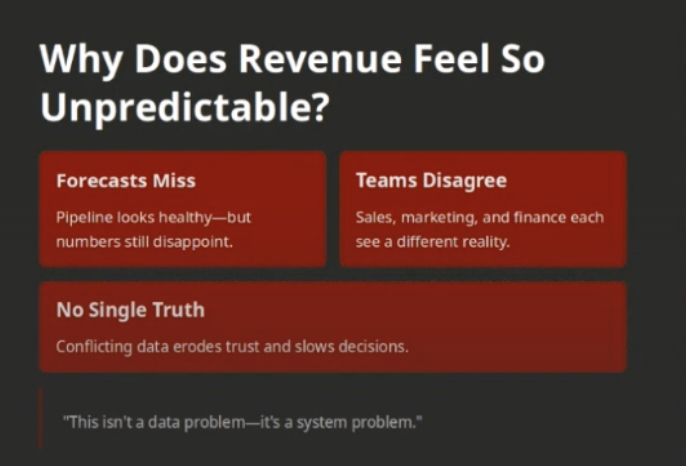
We’ve all lived here. What are we going to sell next month? What are we going to sell next quarter?
How do you answer that question? If you’re the VP of sales or the business owner you get used to using a lot of gut instinct. You try to put sales enablement systems, reporting systems, and RevOps systems in place to give you a more methodical, systematic, analytical way of predicting revenue and seeing opportunities and challenges coming early. But it still happens. We miss our forecast.
Sometimes you miss it in a good way, meaning you exceed it, but you didn’t know it. It’s a surprise. The worst kind of surprise is when you don’t get to your goal.
Then you ask the team what’s going wrong here? And you get ten different opinions. Everybody’s got their own way of looking at it. There’s no objective truth for you to use as an organization. Obviously, that’s a problem.
Like I mentioned earlier, my mindset has traditionally been: RevOps is a team of people. In a large sales organization where you might have fifty or a hundred salespeople running around the country doing their thing, you had a team back in the office that made everything work for the salespeople.
Your team’s goal is to keep things moving smoothly for the sales team. Help them be as effective and efficient as they can be. The things those people would be doing are managing the CRM, creating reports for management, pipeline reporting, and doing forecasting and reporting.
Which is all great, especially in a world ten years ago where salespeople would look at you when you asked them to do their own pipeline report like you’re crazy. I don’t know how to operate that software. But the world has changed a little bit.
In today’s RevOps, it’s more of an operating system. It’s the people, but as much as anything, it’s a process. A process that’s repeatable. That’s the key, so that it runs on autopilot.
You have to have the data. The more consistent and comprehensive the data is, the better. You also have to have the technology that makes using all of that data and process easy. It can’t be work to the team, especially not your salespeople.
The problem that we have in most organizations is you have your CRM, your marketing system, your finance tools, and a whole other set of sales enablement tools. They’re all different things. Maybe they talk to each other a little bit. Maybe you’re buying them from the same vendor, so they’re under the same roof, but they’re still different systems with integration issues and things like that. It’s work just to keep it all going. That’s where the RevOps team spends a lot of their time.
The problem to me, is that all these systems have to work just right to get the result that you want. Keeping them working just right is a full-time job for at least one or two people on your team.
Nobody has the time to sit around monkeying with sales tools. You want them in front of customers selling.
What that means is your system doesn’t get enough attention. It doesn’t get built in a stable, resilient way. Then it breaks unexpectedly.
Now you don’t have the analytics or the automation that you were counting on, and that directly impacts revenue, maybe even today, this quarter, this month.
Now people are scrambling, fixing things, and you’re not being proactive. That’s the real world.
Symptoms of a Broken RevOps Model
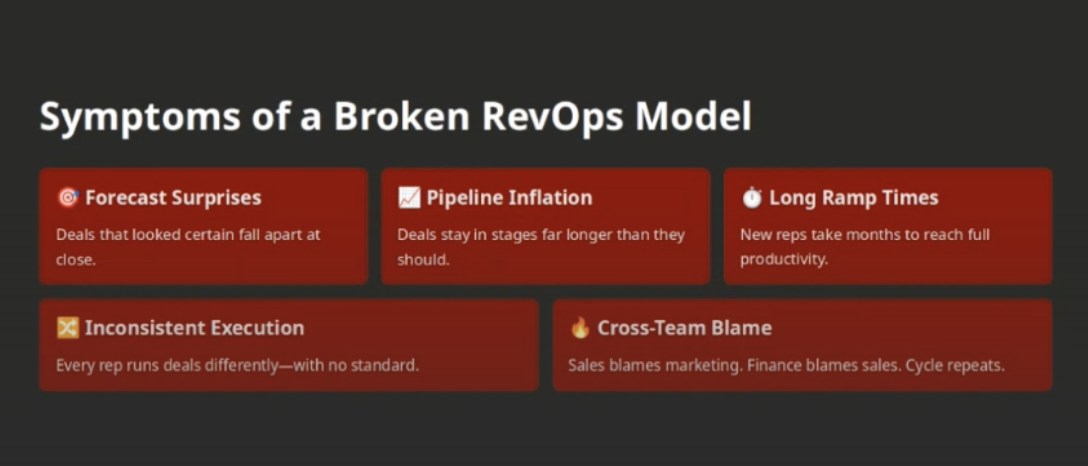
Here are the symptoms: forecast surprises, pipeline inflation. That’s a great term. But basically what we mean there is you’re filling your pipeline with deals that may or may not be real.
There are deals that never go away. The customer sat for the demo and the executives gave you the “yeah, it looks really good.” They told you they were going to talk about it and make decisions, and they just never do.
But unfortunately, because we’re salespeople and we’re optimistic, we never want to take that out of the pipeline.
Long ramp times, meaning new sales hires come on and it takes them forever to get up to speed.
Inconsistent execution. You have one person doing it one way and another doing it a different way. That’s directly related to long ramp times.
Cross-team blame. Marketing is blaming the salespeople, saying “Hey, I’m getting them all sorts of leads, they’re just not closing them”. The salespeople are say: “The leads suck.” That’s the real world.
From reporting – Operating Model
You can automate a lot of this by putting together a system that’s not so dependent on people.
We’re going from a reporting system to an operating model, an operating system.
The old version of RevOps reports on activity, tracks the pipeline, aggregates data, and is reactive.
The modern RevOps approach guides behavior. Here’s what you should do next. Improving execution, connecting systems, and being proactive.
The RevOps maturity curve
Level 1, you’re reporting on things. Back when I was in a VP of sales role for the first time managing a good-size team, it was a real breakthrough. You know, this is like twenty years ago, but it was a real breakthrough to be able to run a report of all the salespeople’s pipeline for the month, for the quarter, whatever, and just have it all in one place and look at it and talk about it. Some of us are still stuck there.
Level 2 is process alignment. You know, we have some defined stages in that pipeline, and we have some rules around what goes in what stage. You can’t move to stage 3 if you don’t meet these criteria, those types of things.
Level 3 is insight-driven. So you’re looking ahead, you’re using the data and the signals to give you insight into the future.
And then Level 4 is an execution engine, so that the system is using those signals of what’s coming in the future to guide your salespeople and your marketing teams’ execution and automate a lot of things as well.
Most teams are not all the way there. Your dashboard’s just—you know, more reports and more dashboards are not going to get you where you need to go.
The one thing that hasn’t changed in my entire career in sales is that more face time with customers for your sales team is the Holy Grail. If you can maximize the amount of time they’re spending with qualified customers, building relationships, good things will happen. You will get more intelligence about what’s happening in the marketplace. You will have stronger relationships with customers, obviously, and that leads to revenue. There’ll be new opportunities uncovered, so your average deal size goes up—all of those things.
In a way, we can look at all of these things, these mechanics that we’re talking about today, as a way to drive that result. Either we’re getting better at getting our salespeople in front of the right customers—sometimes that’s the problem, is we’re spending too much time with unqualified leads—or we’re taking busy work and indecision out of the salesperson’s life so they’re more focused on spending time in front of customers.
So, you know, when we get all the way there to level four, this is, for most of us, including me, this is an aspiration. It’s a goal. It’s something we’re going to work towards. Maybe we’ll never get there, but the closer we get, the better we get.
Your CRM is guiding the next steps. In other words, I just logged a call with a customer, and the CRM is telling me what to do next. It’s not leaving it up to me. In other words, you’re enforcing your process on your sales team without making it a burden on the sales team.
Content in context, meaning—sure, the marketing team gave me this binder full of brochures and product information, and I spent a week in training with the product team, and I got all this information in my head about our products, and I got all these assets that I can share with customers about the products.
But I’m a sales guy. And to me, I’m a sales guy. Every customer seems like a great customer, somebody I’m going to close tomorrow. I’m internally optimistic. So if you just give me all of that stuff, I’m just going to be sharing it with everybody. And that’s not the best thing for the customer.
The customer needs breadcrumbs. They need to be led along a path of education for themselves. So the content that you’re producing for your team to use needs to show up in their face based on the context of that particular deal. This customer just brought up this challenge—aha, here’s the piece to give them for that. It has to be very, very selective and timely.
Managers coach on signals, so manage behavior, not results. That’s a different way to say that. But I think more subtly, what we’re saying here is we’re looking at the signals the customer is giving us, not just the behavior of the salesperson.
So what, to me, in a B2B sense, one of the greatest reasons or most common reasons that a deal kind of goes into that drift stage where it doesn’t go away, but it never closes, is that we’re just not talking to all the right people at the organization. The one person that we have a relationship with that seems very excited about it just doesn’t have the full authority to make the decision. And the other folks involved we’ve never talked to, and they have other priorities, and we’re just not aware of it.
So that’s a signal. When your champion won’t introduce you to the other influencers, that’s a pretty strong signal that, in most sales organizations that I’ve been involved in—either directly involved in or even with our customers here at SalesNexus—you just kind of ignore that. Again, it goes back to that optimism. We want to believe. And that’s why we need to base these decisions on data, objective data.
Behavior-based forecast. So it’s not, “Hey, this customer over here is currently spending fifty thousand dollars a month on our competitor’s product, so I’m going to get them closed next quarter, and that’s going to be fifty thousand dollars a month in my pipeline.” Okay, great. But what have you done to lead us towards that deal? The pipeline should not be reflecting fifty thousand dollars a month if you’ve only just had an initial phone call with one person there.
OK, so what’s the system of the future, the system that we’re working towards here look like?
Well, obviously your CRM is where the customer information goes—the deals and the activities. But there’s a lot of other components.
The LMS, learning management system. So this is where, in a lot of medium-size or smaller organizations—what if you’re lucky, you’re sending your salespeople to some, you know, like a Sandler President’s Club-type training thing, where they’re getting trained sales practices and principles—but it’s not sales training in the context of your business or your customers.
In a larger organization that’s getting close to this level four that we’re talking about, they’re going to have a learning management system so that when you’re onboarding a team or onboarding a salesperson, there’s a structured set of lessons for them to go through. And only after they’ve cleared all those lessons and successfully taken the quizzes or whatever do they get to go on to the next step in their training or whatever.
There’s the content and the messaging. Are you letting your salespeople write all the emails describing your products to their customers? If so, then by nature you are getting very inconsistent communication with your customer.
That’s one of those details that, back to what we were talking about before—you’re looking at your pipeline, you’re looking at kind of the close rate on an individual sales rep basis—how do you even surface the fact that this one guy who keeps losing these big deals at the last minute, the emails he’s sending about the product just kind of suck? How do you even see that? Most teams, they’re just never going to get that deep.
You have to have a way to standardize the communications, the content, so the path of least resistance for the salesperson is to send the best stuff that your team has put together.
And then there’s the AI layer. We could spend thirty minutes on that topic, but try not to go all the way down that rabbit hole today. It’s important, and it’s not just a research tool.
That’s what I see today most sales teams are trying to do. They’re using it at the top of the funnel to get information about a customer, and then they’re using it to automate messaging. But there’s a whole other realm that most teams aren’t really thinking about, and that is:
How can we use AI to look at our own process and make it better.
The Problem with Today’s Stack
The problem with today’s tech stack is you got your CRM and it’s tracking how many meetings you had and those kinds of things, how many calls you made. Your LMS is tracking whether you watched the training video. In a lot of cases, sales management is not even getting feedback as to whether they really absorbed or mastered the material. It just says yes, they completed it. That means he sat there with his phone watching a YouTube video while the training video played. How do you know?
CMS stores content but doesn’t surface it when and where it’s needed. A customer sends an email saying, “I’m confused because you have this one product that does this, you have this other product that does that, but it seems like they both would work for my application. What are the trade-offs?” There’s no reason that your system cannot detect that this is a question that requires a particular piece where your marketing team put together a comparison of the pros and cons of each product line. AI might be part of doing that.
The way a lot of salespeople are using AI is it’s just a chatbot in a tab on your computer, and you can go ask it a question when you want to. That’s fine, but it’s not really in the process. The way we’ve always built sales systems is we don’t want distractions for the salesperson. We want them to have their cup of coffee, sit down, boot up the system, and see the people they have to call today and why they’re calling each one of them. Everything they need to know about their current relationship is there so they can just go: call, call, call, call, call, and log what’s happening.
The system helps easily take follow-up actions without jumping around from one screen to another. In a lot of systems, you’re doing that in your CRM, but then the customer asks for a spec sheet or some material. Now you have to go to your content management system or your marketing automation system and make sure they get added to the list to receive it. Then maybe you go to the chatbot to research the company before calling them. There are too many windows, and as a salesperson, you’re not going to be very focused.
It needs to be simple. Tell me what to do. Tell me who I’m calling, why I’m calling, and let me follow up so I can move on to the next person. That’s where it all starts. If I’m depending on calling people as part of my process, that’s where things break most often. You just don’t get enough calls made, and all these distractions are not helping.
What Good Data Flow Looks Like
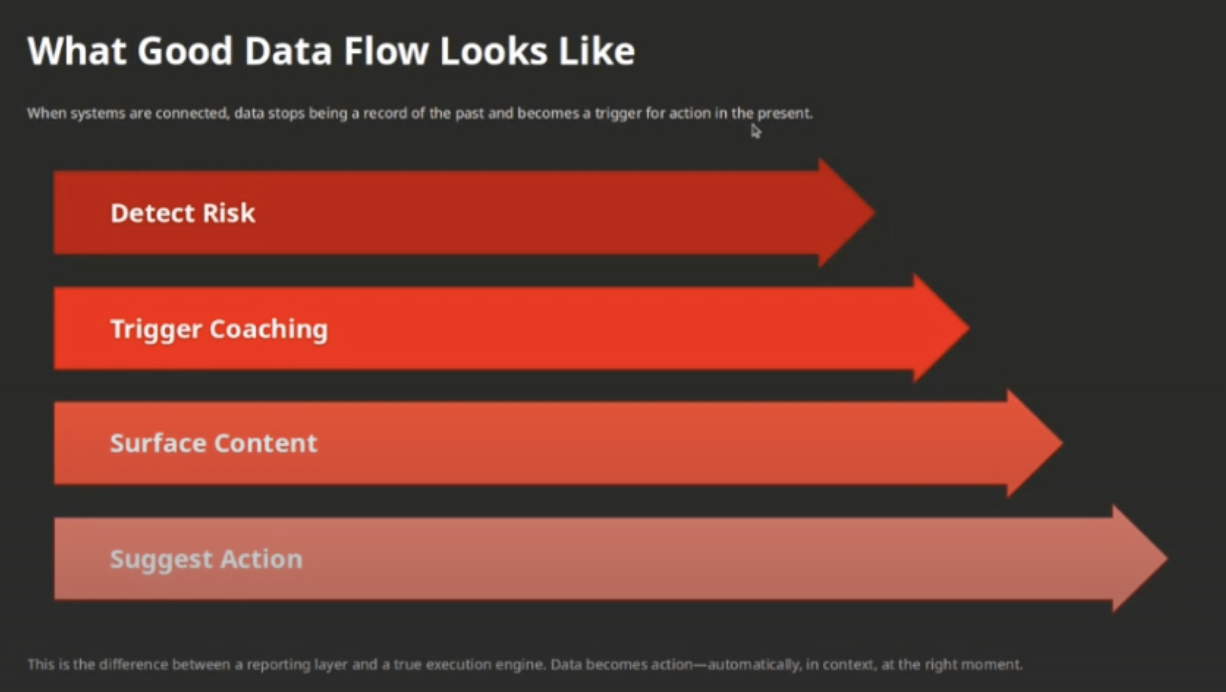
What does good data flow look like? It’s detecting risk. It’s seeing things like a big deal moving through the pipeline nicely, with a lot of dialogue—calls getting logged, email exchanges—and now it’s in the proposal or closing stage, and you haven’t heard from them in a week and a half. That’s not a good sign. The system should be alerting management and the sales rep that – “Hey, we need to do something here.”
It’s triggering coaching. So I can see on a daily basis, even an hourly basis. Sam over here, that guy makes his calls all day, every day. He’s exceeding our expectations for number of calls made. And then I got Susie over here. It doesn’t matter what I do. She’s never going to make enough calls. She’s always lagging. But on the other hand, Sam, even though he’s making all those calls, he just kind of doesn’t get that many appointments. Susie makes far fewer calls, but she gets a lot of appointments.
Those two people need totally different training. To take them both on a Friday and put them in front of the same trainer or the same video or whatever, it’s just foolishness. You’re just going to aggravate them. Sam needs some coaching on what he’s saying on those calls. Susie needs some coaching on just cranking up the volume. And your system should identify those opportunities and provide the salesperson ideally with the right training and content in real time.
There’s no reason it can’t be daily, just a quick little ten minutes at the end of the day. Hey, based on what happened today, here’s a little video you might want to watch. Surfacing content, we’ve kind of touched on this a few times. We’re finding the right piece of material, videos, PDFs, spec sheets, buyer guides, pricing guides, lists. Sometimes can be a very mundane thing. But it’s the right thing at the right time for that customer.
And then suggesting action for the sales rep. Based on what we have, based on what we see has happened with this customer today and in the past, the right next thing is this. Here’s everything you need to do it. Click go. It should be that easy.
Data should guide behavior, not just describe history. We’re looking for a dashboard, like in a car, not the dashboard that you get from Salesforce. It’s not just here’s what happened yesterday. It’s here’s the early warning signs that helped me determine what’s going to happen tomorrow.
It’s maybe if I’m sticking with the car analogy, there’s a difference between the speedometer or the odometer. The odometer tells me how many miles I’ve been. How far I’ve been. That’s important to know, but it’s not helping me know anything about the future. The oil pressure and the water temperature, those are things that tell me something about the future. They’re not as sexy really as the speedometer or the odometer. It’s fun to go fast and it’s fun to go far. It’s not fun to think about what might be going wrong with my car if my oil pressure’s too high. But if I ignore that, I’m going to have a problem. I’m not going to get very far and I’m not going to be going fast.
So that’s what we’re looking for. We need to find the data in your business that tells you is your machine operating at peak performance and where are you headed.
So we got vanity metrics and real metrics. How many calls did I make? How many new deals did we open up this month? What I think is a big part of the problem here is, especially in a larger organization, but even in a smaller one, the upper management does not always come from a sales background. They can be dazzled with metrics very easily. They just don’t know what matters and they don’t know how squishy some of these numbers can be.
Calls made. As the VP of sales I can walk into my CEO and put a report on his desk and say look at this boss we went from making an average of ten calls a day last month to twenty calls a day this month. Who doesn’t feel good about that? But anybody that’s been in sales very long, you know, that doesn’t really mean that much if you don’t dig a little bit deeper.
Metrics that Actually Matter
So what are real metrics? Content views. If we’re doing a great job of everything that we’ve talked about and we’re sending the right content to the right customer at the right time, then those customers should be valuing that content. We should be seeing them consuming it, watching the whole video, not just getting an email and hitting delete. Downloading the white paper, coming back to us after looking at the content with follow-up questions. Those are all the signals that the content’s working.
Training completion, certifications earned. Those are, like we talked about earlier, kind of depends on the quiz. I may have gone through it, but it doesn’t mean that I really onboarded the lessons. It’s once I get out into the field that I have to execute on what I learned. And it’s there that we have to measure their behavior to see are they changing their pattern?
So you’ve got to have a system that’s giving you those early warning signals. Honestly, my thinking at this moment in time is you kind of have to have both. Not only does your CEO just kind of want to see the vanity metrics, but he’s then got a board or mentors or bankers or whatever that he’s got to report these things to. And at some level, they just have to give that person what they’re asking for.
In some case, you can’t bring your banker a report about how many of your customers told you some mundane specification detail. But you’ve determined in your process that that’s the real key. If they’re using this particular type of material or whatever, you got a high rate of success with that customer. You can’t bring that to the banker. So you’re going to have to do the vanity metrics and have those reports, but you also have to have a discipline as a team to keep your eye on those how’s the motor running kind of metrics as well.
Some metrics that we can try to focus in on: stage conversion rates. How fast do I go from this stage to that stage in my deal pipeline? Or which of those stages do people tend to stall at? That’s actionable information. If we’re going from one stage to the next, we’re going from stage one to stage two very quickly but then we always stall in stage two – we stay there way too long. Well what we know is we need to keep them in stage one for a little longer. Do a better job of qualifying and so on and so forth.
Deal velocity — kind of the same thing. Time in stage, rep consistency.
For me, one of the key ingredients has always been data capture. So in a CRM company, what that looks like is I give my sales team fields to fill out about their customers. That’s the way we’ve always thought about it.
There are certain things you just know you want your salespeople to ask every customer, right? Like we talked about a minute ago — that one little part: which model are you using, right? Because our machine works better with that model or whatever.
It’s those little details. And what you want to do is give your salespeople an easy way — like I talked about earlier — they’ve got that one screen, they’re on the phone with the customer, and they can just see at a glance the key questions that we know we need to ask our customers.
“Here’s five of them that I still don’t have an answer to.” So I’ve got to find a way in this conversation to get some time and direct the attention over to those questions, right?
That’s a really powerful tool. Number one, it’s a great way to not eliminate, but vastly improve problems with qualification and deals stalling. But it’s also a way to analyze rep behavior.
You can see easily: these sales reps are consistently getting all of that information. And these other reps over here either aren’t getting it or they’re not putting it in the system.
And you can analyze their success rates and how that changes things. What I would bet is the guys that get all the information right up front put fewer deals in the pipeline, right? Because they’re disqualifying them early.
But the deals that they put in there have a higher close rate and they go faster.
Depending on how you’re reporting, if you’re looking at those vanity metrics, you might actually be rewarding the guys that are doing it wrong — because it looks better. In the reports that you’re looking at, it looks better because they’ve got a lot more deals in there.
So this is definitely a journey. It’s not a destination, right? Because those little things are not always obvious — they’re sometimes counterintuitive.
And you always have to be tuning. It’s like you’re the chief mechanic for a race team, right? You’re trying to beat the competition. Everybody’s out there finding new ways to tune their car, and even though you think you’ve got it 100% tuned, if you’re not beating the competition, then you’ve got to find some more ways to tune it.
A really key metric that I don’t see often — in businesses I’ve been involved in, it’s very rare to even have any consistent way to measure this — probably in larger organizations with more of an HR team, training team, etc., it’s a little more common.
But knowing how long it takes a rep to get ramped up and be productive is super important.
If you think about it, it’s no different than measuring the ROI on an advertising campaign. I’m going to spend $10,000 this month to get this many leads, which will turn into this many deals, which will turn into this much in sales. What’s the ROI between the investment in the ads and the income in sales?
Same thing with a salesperson. I’m going to spend a lot of time and money finding, hiring, and onboarding that salesperson. And it’s going to take them weeks, months to pay all that back.
If I can compress that time from six months to four — do the math in your own spreadsheet — it’s huge.
It allows you to scale your business tremendously faster. Because you’re not waiting. There are only so many salespeople you can add to the team if they’re all going to cost you money for six months.
But if they only cost you money for four months, you can add more. You can either stagger them and add them more quickly over time, or just add more in the beginning — because you’re not investing as much time and money in them in the first place. So that’s a huge one.
Win rate by rep — we’ve kind of talked about that a few different ways already.
Coaching impact — again, this is a tough one because it’s up there at that level four like we talked about earlier. Being able to tie it all together and say, “Hey, this rep’s win rate went up because we were able to coach them in these different ways” — to tie that together is a challenge.
You have to look for the opportunity. It might be as simple as: these sales reps are highly engaged in our training tools, and these other reps are not, because we’ve left it up to them — made it a little bit optional. And how do their results change over time?
I think the other thing about the coaching part is — just like in a sports team – baseball, football, whatever — there are some people that have raw talent, and there are some that don’t.
But on the flip side, there are some people that are coachable and some that are not coachable.
So to me, that’s the thing you want to try and measure first: when we’re providing coaching and training, are we seeing them change their behaviors — or at least try to — in the real world? Or are they just going through the motions and using it as a way to take Friday off?
The Big Shift in Measurement
From what happened to what do we do next — we’ve kind of talked about that.
We want a dashboard that gives us early warning signs that tell us how our engine is operating.
Forecasting Reframe
Forecasting — a bad forecast is based on “I’ve got some deals in the pipeline, I have a few stages, and if they’re in stage four, that’s better than stage two, so we give it a higher percentage.” Everything else is subjective, left up to the sales rep.
You’re just always going to be over-forecasting in that situation.
A good forecast is using the buyer’s engagement as a signal for where they are in the process.
Deal health scores — do we have relationships? Have we built relationships with all the key influencers? Do we even know who the key influencers are?
Execution quality indicators — are we doing things in the proper sequence and at the proper cadence?
The RevOps Design Framework
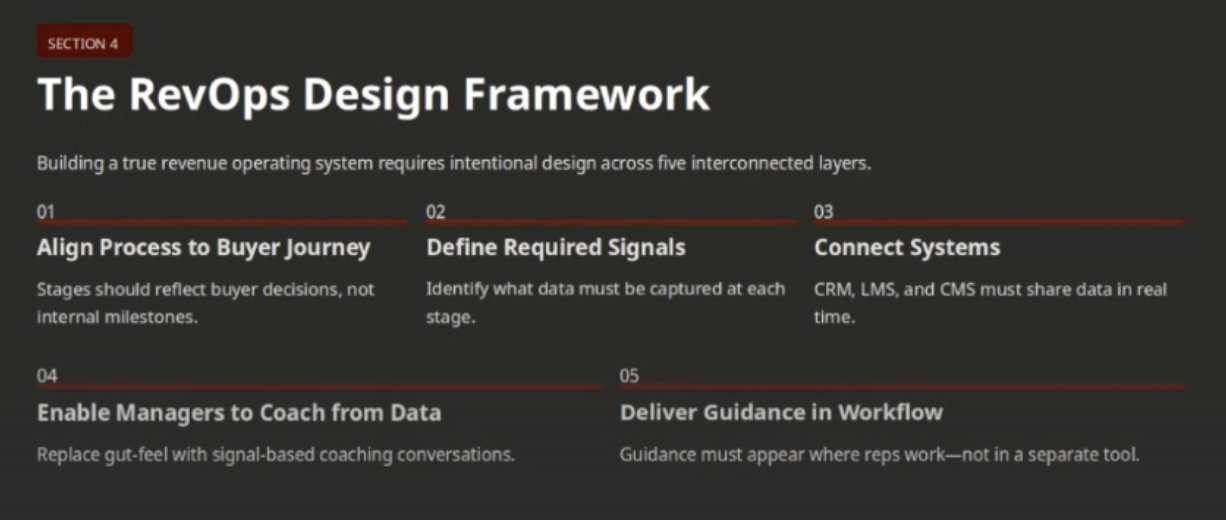
Aligning the process to the buyer journey. Define the required signals. What are those little oil pressure indicators we’re going to look for, connecting all the systems together so that when I am not logging enough calls in the CRM, automatically somebody or some system is going, hey, Craig needs to take a look at this video about making more calls.
Enabling managers to coach from the data, just like what I just said. It may be watch a video or it may just be let my manager know he needs to walk down the hall and have a talk with me. And what about, like what specifically, not just, hey, how’s it going? How’s your pipeline look? Let’s get real specific. Help me, be, don’t be the owner of the team. Be the manager on the field that sees the way I’m standing when I’m swinging the bat and can tell me, hey, pick up your elbow a little bit now, try it and watch how that works and give me a little, coach me.
Deliver guidance in the workflow. Tell the sales rep, hey, do this.
Where to Start?
So where do we start? Forecasting obviously important. Start doing your forecasts and layering on the signal data that you’re starting to think you may want to keep your eyes on. Look at those deals and give them a grade based on the oil pressure and the water temperature and all of those other things. Things like completion of profile. Have we asked them all of the questions we need to ask them? Do we know all of the decision makers? What’s our engagement rate? Are we talking to these guys every day? Are we talking to them once a week, once a month? Are there some of them we’re just not talking to?
All of those things need to be part of ranking your deals. You’re going to have to do that for a little while to see which numbers are the ones that really drive performance. So my advice is don’t wait around until you’ve come up with the perfect system or don’t go and buy all new technology and wait for all of that to get set up and working so that you can start this. Start doing it now with the data that you have because you’re going to see a lot just by looking.
And it’s down the road. When you’ve done it a little bit and you’ve started to realize what numbers really seem to matter, then you’ll know a lot more about how the tech stack needs to work for you.
Where are deals stalling? Usually what that means is whatever happened in the stages before that, there wasn’t enough qualification going on. We weren’t being clear about budget and decision-making process and those kinds of things. And we know at that stage, whatever we’re asking the customer to do next, they’re not ready for. So we may need to break that stage they’re stalling in into two stages or more, but usually just two stages, where the first of those two is a sort of an education type of step because what’s usually happening is you’ve kind of hit them with oh wow yeah I see how we have a problem and maybe we could increase revenue if we did this or we could cut costs we did that and you have some solutions that look pretty good you’ve educated them about a problem or an opportunity and potential solutions. And now they’re just kind of, “Whoa, I got to do some analysis of this and I need to go do some due diligence and look for other potential solutions. I’m not just going to buy from the first guy that walked in the front door.” So you need to guide that process, know that it’s happening and be there to guide it. Rather than just immediately going, hey, are you ready for a proposal?
And we’ve talked about rep ramp. How quick are those guys getting to where they’re producing profit?
So an example, if you’ve got late stage deal stall, your deals are getting close to closing, but then they stall. There’s no clear risk signals visible. I didn’t see that coming. Managers are relying on the rep updates. So whatever the rep tells me, that’s what I’m telling my boss.
So once you’ve crossed this Rubicon, as it were, you have defined exit criteria for each stage, like I’ve talked about here. Is that whole customer profile filled out? Do we know everything we need to know about the customer? If not, you don’t get to go to the next stage. Risk alerts are triggered automatically. No contact with the customer in two weeks. Coaching aligned to deal signals.
Complex deals especially. A lot of times it’s very much about negotiation and deal structure. And those are skills that when you have somebody on your team that has that skill set and has a good experience with that, they can be so valuable to the sales rep. But the sales rep has to be ready to hear it. So you can’t just lock everybody in a room on Friday and say, hey, you’re going to listen to Bob over here because he’s our master negotiator because they’re not ready to hear it. They don’t need it right now. You’ve got to show up when you see that that deal is getting looks like it might be real, but the customer is going to need it to be structured in a certain way. That’s when you jump in and help that sales rep with that.
Key takeaways for today. RevOps is not a reporting team. It’s not just the people on your staff that run the reports and massage the data and keep all the tech working. Tools aren’t going to fix this. Not unless you’re able to align the tools into some kind of consistent system. That’s stable, doesn’t break all the time and consistent. Data has got to be the guide to your behavior. What we know about the world today tells us what we should do tomorrow.
If you want to really dive into this, I’ve been in sales for a long time. I’ve worked with a lot of folks that run sales organizations and I’ve kind of seen the good bad and the ugly. I feel like I know enough to be dangerous at least. If Mark was here he might slap me and call me an idiot because he definitely has a lot more experience and knows more than I do. Even in spite of my overconfidence, what I do know is that I don’t always do it the best way possible. All of us need that objective look from outside because you just kind of don’t see what you don’t see.