In this session of the RevOps webinar series, Craig Klein is joined by Mark McNamara to move beyond theory and into execution, where strategy meets real-world impact. After laying the groundwork in previous discussions, this conversation dives into what it truly takes to build a high-performing revenue engine. Together, they explore how organizations can create systems that accelerate ramp time, boost productivity, and sustain long-term performance without burning out their teams.
This conversation centers on the evolving role of training and coaching in a world shaped by constant technological and cultural shifts. As attention spans shrink and distractions grow, the challenge—and opportunity—lies in rethinking how we develop, support, and empower sales professionals to succeed.
Marc: I have to say, this particular presentation is really close to my heart. For all the years I’ve done this, it is about, at its core, training and coaching.
Technology, our cultural influences, our distractions, electronic distractions have really changed the way that people pay attention to things and the way that we want to nurture people to success.
I was with an organization called Brain Shark for many years. We were focused on onboarding to everboarding kind of journey. And we used to do everboarding many, many years ago. I think people really tried harder. I’ve talked about Xerox and IBM and all of the mentoring that they did before you were allowed to go out and do any job.
And as we’ve moved forward and everything has sped things up and looking for increased productivity, we’ve really interfered with the ability to nurture people along in what was a career for a long time.
Really getting solidly in line with a company and doing the best you can and making continuous improvement to become a superstar. And I think people do want to be superstars.
And what’s the obstacles? That’s what we’re going to talk about. And how do we fix that?
I think that for many companies, what are you doing when you bring on new employees, whether they’re sales or not, but focused on sales?
How do you get them started?
Is that a one-on-one training session? Do you have a library of material you want them to look at? In a lot of organizations, we’re going to talk about some of the mechanisms that are used in many companies that are available to everybody.
But how do you look at this and really put a process together that is consistent?
I’ve had experiences in companies where they do a good job or they intend on doing a good job and it falls away because we get so busy. Reps have a good start. The first thirty to sixty days, they’re drinking from the fire hose. You may put them into an LMS, and then it starts to really decay, and it’s fast decay, and they start to hit obstacles.
Onboarding Works… Temporarily
Onboarding is often structured.
We have clear expectations: look at these courses. If you’re using an LMS or here’s a list of videos and maybe a quiz or two.
Or maybe you sit down with a manager and they query whether you got it or not. Everybody works a little differently. It tends to be more formal.
Then the formality falls away and one is thrown into the real world. Go do the work.
In many cases, I’ve seen organizations say you’re going to be productive or you’re not. If you’re not, you’re going to have to go find another job. It’s quota.
And yes, we’re forgiving on quota. Not everybody makes one hundred percent, but we’re back to our ABCs and D performers.
What do you really want?
You don’t want to have a treadmill or a hamster wheel of bringing people in on a continuous basis, but working them toward success and continuous success because you’re making big investments in people.
What you want them to do is to make an investment in you.
I was just talking to Craig about this, particularly with young recruits, sales recruits who are coming out of school looking for jobs.They have a lot of questions. When they enter the real world, there’s a list of questions right here.
How can I really be successful in this environment? The first thing when I’m consulted on hiring, the candidate says, “Okay, this is a cool job, but what are you going to do for me?” Training for success is often number one or number two on their list.
So how do you ensure that, given what they’re going to face once they get out there? Because they know how it is. Furthermore, they’ve sat through enough death by PowerPoint that they want something different.
Training is an Event, Selling is Continuous
So the main message today is that we often see training as an event. But selling goes on all the time.
So the reverse of that is training enablement is continuous. It doesn’t stop because you’ve taken two or three courses or watched a series of videos.
Okay, you’ve been onboarded, but let’s move it forward. What does that mean and how can it work?
This is a challenge for a lot of organizations.
Overall, because many smaller companies have sales management, but sales management is not sales training or sales enablement.
To enable is a whole different set of skills and focus to really deliver on what I call the skills-based elements of enablement, not the transactional.
If we think of enablement, it has two goals: Can we increase efficiency?
Like many of us, we’ve invested in a lot of tools to do that, including the CRM.
The CRM makes somebody more efficient. But the goal of training and coaching is to make people more effective. And effectiveness will deliver huge value, which is hard to measure often.
But we often see that value come in the shape of no discounting or less discounting or deal trajectory or very simple quota achievement. Because you’re more effective at what you’re doing.
The Result: Inconsistent Execution
So these are some of the issues that occur in organizations.
I don’t want to spend too much time on what gets in the way, but we’re all creatures of habit. We’ve done it this way for a long time. Even though we have great goals, we fall back to what’s familiar, particularly managers who have a lot of experience and in some cases haven’t really thought through how to use technology differently or even how to create a process with people who are under them that aren’t used to coaching.
One of the challenges I had in a very large technical company was the chief revenue officer and I had a conversation. I was consulting with them, and he wanted to fire all his managers. He had 300 field managers and said none of them are coaches. They’re just people trying to get a forecast.
Well, that’s not coaching. You need to help your people do the work, not necessarily ask them what they’re going to close. And that’s an extreme example, but it happens on a small level.
If we’re a founder and president and chief sales officer, we may not have time to be doing a lot of coaching. So we want to have people that can do the job without a lot of training. So we hire someone more experienced per se, but they’re not delivering and we don’t know why. It may be a lack of training and coaching.
Craig: For me, the way this has happened in my career is in kind of smaller companies generally, but sometimes when you’re really in growth mode you’re hiring several people at a time, or all close together. And they end up kind of being like a class that come up together. And that way they’re mentoring each other. They’re just like study buddies in college or whatever, and that can be super helpful.
But as the manager, you start off with the best of intentions. Hey, I got this one new salesperson or five new salespeople, whatever, starting on Monday. I need to clear my calendar and make sure I got ample time to really spend with these guys and help them get off to a good start.
But in my world, it’s never been even so structured that that plan went beyond like the first ninety days or something like that. I was like, I’m going to try and spend as much time with you in the first ninety days. And then you’re kind of on your own and then I’m going to watch the numbers. And if I start to see some issues, I might give you a little bit of one on one coaching.
But even in that not so great plan, what actually happens in the real world is it’s that first week and you’ve been really spending a lot of time with that sales rep. But you’re also helping some of the older guys close some of the big deals that are really gonna make your quarter or whatever. And something breaks loose on one of those deals. And now you’re having to huddle up with them and you’re having to cancel your training meetings with the new sales reps. And reality just kind of takes over and reprioritizes your focus.
And what you were saying just a minute ago about having the people that have the skills and the know-how and the time to really focus on the onboarding the ever boarding the training, that’s key. That’s tough in a smaller business. But the other thing that I think is really important is that you just have to see it as something that’s more organic and day in and day out. It can’t be like you said earlier you go to a training and that’s an event. It’s more hey I’m playing baseball with my son I don’t go out there for an hour show him the mechanics and say all right good luck. I’m after every at bat I’m giving them a little bit of input. And that’s it’s kind of a real mindset shift that you’re helping me see for sure.
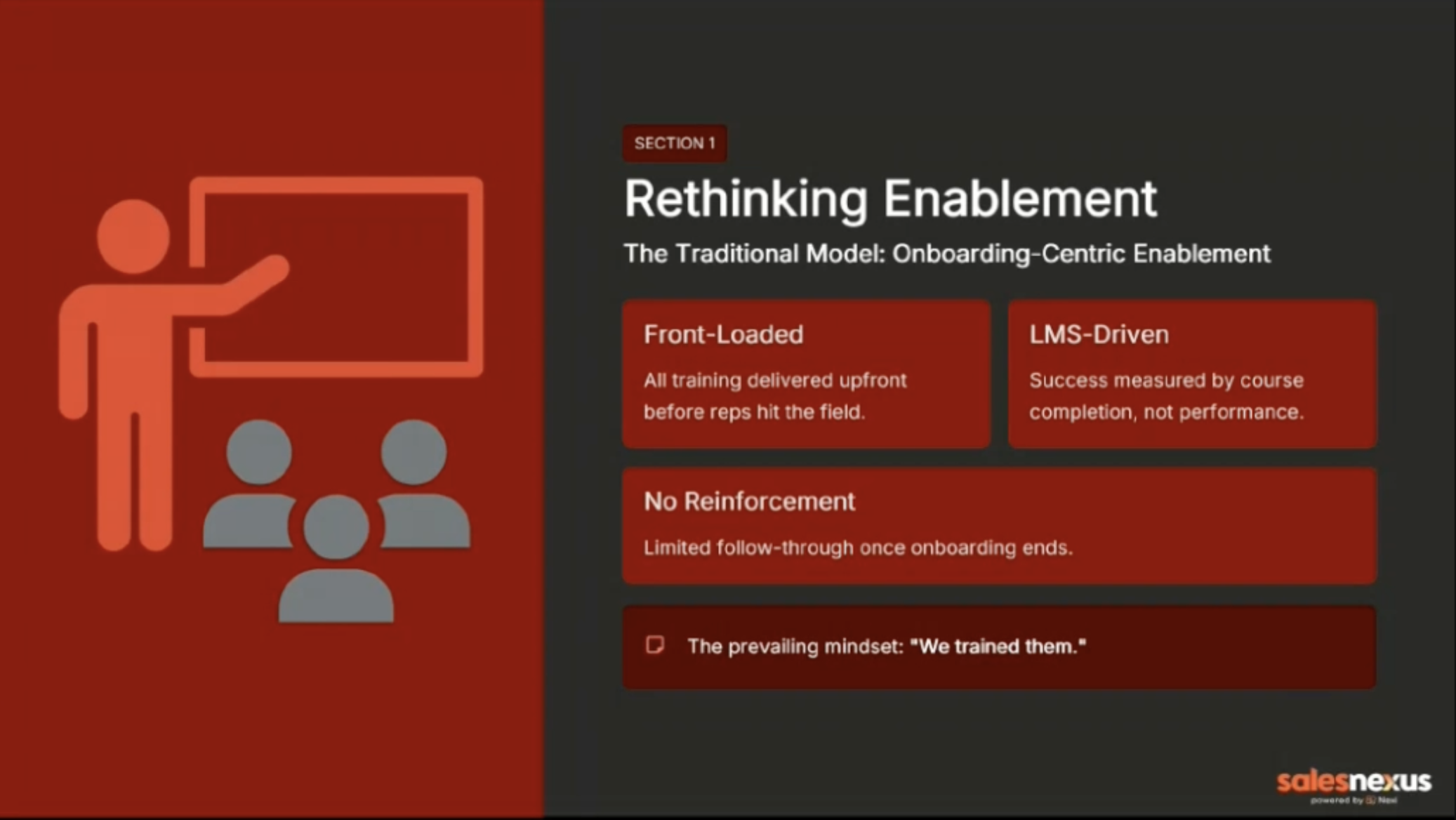
Rethinking Enablement
Marc: I’ve done a lot of this at a very high level, with a lot of large companies. And I’m really trying to get this driven down to where it can work for mid market and smaller, because this is the way it’s going to help.
And I think you brought up the buddy system and there was one other point in there is that the tribal knowledge, and the shared knowledge is priceless. And it’s the things and salespeople are funny. They create habits that work for them, but they don’t always wind up sharing them, because they’re a little competitive in one company. My way is gonna make me a hero and I wanna be the hero.
But what we found is that there’s even a way to incentivize them to share those stories and make that common knowledge. Because that tribal knowledge, if you can collect it, and share it is really, really valuable.
Craig: My first experience really as a sales leader of a decent sized team, we’re in a technology company in the energy business. One of the sales reps was also one of the founders, old guy, like our age back then.
And we’re trying to implement a CRM just so we can start having some kind of pipeline report. And Joe, he barely even used a computer. He hardly even used emails or whatever. Back then. And so we just never even assumed that he would use the CRM. So we literally trained one of our admin assistants to be like his input person. He would just call him up every day and go, hey Joe, who’d you meet with today and what happened and blah blah blah. And she’d update the CRM because we just didn’t want to disrupt what Joe does. Because he was a big part of our revenue.
Point being pretty soon, the other sales guys start to talk amongst themselves about here’s what I’m using the system for, and here’s how it’s helping me and stuff like that. Next thing you know, Joe wants to be involved in that. He’s going hey whoa what are you guys up to over here. You said salespeople are competitive, but they’re competitive in a good way too. If they see somebody doing something that’s working, they’re gonna learn all about it.
Marc: There’s so many ways to really, I’m jumping around. But the idea is to create culture. Culture is key as part of it. And having the workflows that support the culture, knowledge sharing is a cultural thing.
And one of the things that you think about as a leader is how do I create a learning culture? How do I encourage all of this? And this is part of it. This is part of the thinking.
But to keep going, it’s really a rethink. It’s really a rethink. And some of it is stop thinking it’s totally front-loaded. Rethink how success and what I mean by that is knowledge competency skill is measured.
The LMS method, which many of us have gotten familiar with, is measured by completion, not necessarily performance.
One of the things about learning, even from classroom learning to online learning, digital, whatever you want to call it, is that when we’re trained or presented with information, we start forgetting the second we don’t look at that content anymore.
And I had a great sensei, I used to take Kung Fu, and he talked about muscle memory. And I used to use that term with customers to say what sales needs is muscle memory. It’s even like using software. The first time you use a piece of software, I know how to do that. And you don’t use it for 30 days and you come back and say how did I do that. You haven’t developed that muscle memory, that consistent repeat so that it’s habit.
And the same is true of knowledge. If you stop using knowledge, if you stop applying knowledge, you lose it. You forget things. You’re not as sharp.
And a lot of salespeople want to believe that I can read something again and in two minutes I’m up to speed and I’m rocking. And if you use sales engineers, that’s not the case at all.
What you want to do is instill learning into their work. So that in the case of a sales person, yes, you’ve onboarded them. You’ve given them context. Onboarding is about context, not necessarily every piece of knowledge that they need, because knowledge is going to be remembered at the point of need.
When we use something, we apply it. That’s when we understand its value, how it fits into the activity that we’re doing and how it reinforces our ability to be successful. And as a result, we remember it.
We put it into our own personal words and process that makes it real.
And then yes, I’ve used it. I have a religion around it. I believe in it. But then again, I drop off. So continuous reinforcement is really, really important. Keep your skills sharp.
You use the baseball metaphor, Craig. Every football coach, every NBA coach and manager. What’s the key? Get out there and practice.
What do you do? Go out and I want you to shoot a hundred foul shots. Why? You got to have the muscle memory. But coach, I was in the game last night and I’ve shot twenty. It doesn’t matter. Wash, rinse, repeat. Wash, rinse, repeat.
Craig: Back in the day, it was the ride along. Your manager would get in the car with you and you’d go drive around and see clients and you go in there and talk to them together.
And that’s just the same as you’re in the batter’s box, swinging the bat, and your coach is watching you do it so he can give you real-time feedback.
It’s harder today, I think, or it’s less organic because we’re all just sitting at our own computers on our own phone. We’re not out in the field as much. And so now you have to use the technology to get the feedback to know where the coaching is needed.
Marc: That’s true. I think there are other things about technology that have made sales harder. How do you read a room when you’re in a Zoom meeting? That’s a challenge. But there are ways to coach people on that.
And there’s even, believe it or not, technology, which is kind of scary, that will look at facial expressions and give you notes back as to how someone might have been thinking. It’s like playing poker. If anybody’s a poker player, what’s the tell? Tug their ear, twirl their mustache, whatever it is. Those things are out there and they can be taught.
The Modern Model: Everboarding
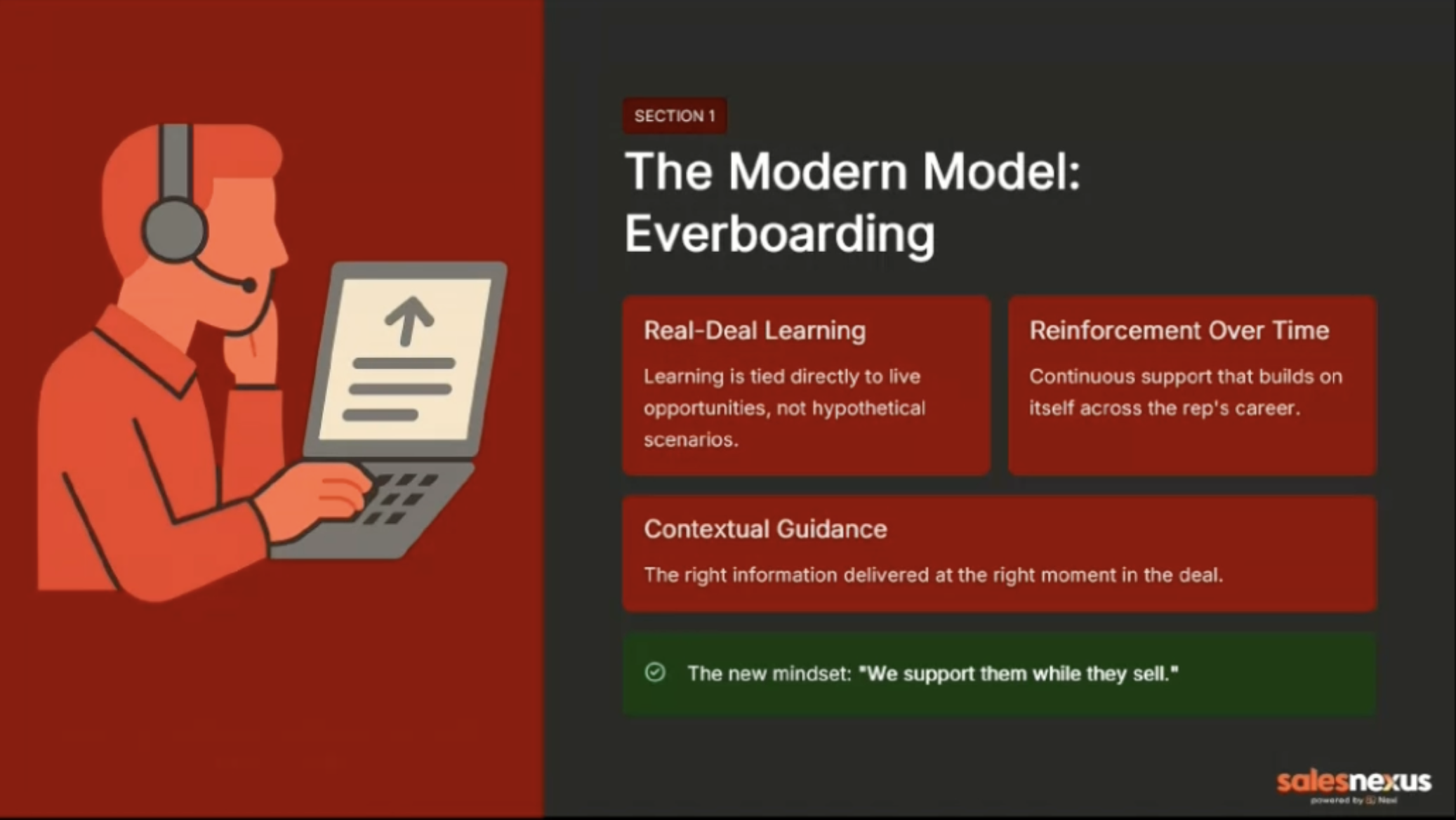
So I’m repeating myself, but everboarding is an ongoing process. It’s in-the-moment support that helps perform in live opportunities. So you’re onboard, you everboard, and you never stop. And that’s really the key.
Take, for example, the playbook. How many people have paid for playbooks or have developed playbooks? I’ve worked with many organizations where these playbooks often wind up either as a series of slides or as a PDF with a hundred pages. And it tries to deal with every set of circumstances with every persona in the industries you’re selling to. Salesforce tried to perfect the whole model of how to deliver that in ways that are complex.
Nobody’s going to sit down and read that playbook. It just doesn’t happen. And when you’re in a call, you’re not turning pages to figure out what to say. So what is it? You’re going to sit down and study that? That doesn’t work.
But that knowledge is still important. There’s tribal knowledge in there. There’s executive knowledge in there. You’ve got a whole marketing team, or you’re doing the marketing and creating messaging, and you want people to embrace that.
So there’s a whole component of bringing that into the system and storing it and using it in such a way that benefits the rep in the context of their work. And that’s really what I’ve been doing and helping companies do for many years, well over a decade.
So these are just some changes to think about. I was just talking about a content library, how to remeasure people. We always say go study. No. We’re all used to now the Google generation, and now it’s the AI generation. Tell me what I want to know. I don’t have to remember anything. Somebody else is going to remember it for me.
What is Sales Readiness?
So there’s a shift, because what we’re really talking about is making salespeople ready at every moment that they work. And what is that? If you haven’t heard the term sales readiness, it really is about knowledge and giving them the knowledge and giving them the tools to use that knowledge well.
They need to know what to do. They need to know how to do it. They need to know what tools to do it with and when, and not to break down and panic. And that’s what all of this promotes—making salespeople ready at every moment to deal with every scenario.
But this breaks down because we haven’t handled the knowledge well. We haven’t put it into a format that makes somebody successful in dealing with the moment. And the more you see me talking about this, the more you start to realize that there are processes and technology that can help here, because readiness breaks down in the field.
To your point, Craig, it used to be the ride-along. It used to be mentorship, sitting in the room. You go from apprentice to journeyman to salesman. So there’s a whole execution path there, which was enablement. We just changed the name of it. And the gap is what they know versus what they can actually do.
So how do we fix all of that?
The Everboarding Life Cycle
So the lifecycle is on board, start to apply, reinforce, give them opportunities to adapt, and repeat. We used to do this with human resources. We started using more technology. Sales Nexus is a great example of being able to apply new methods of bringing things to sales. AI is assisting there quite substantially.
The other side is how you encapsulate and start to deliver the enablement, the readiness, the training on a continuous basis that we’re talking about here.
Does this approach align with any specific sales training methodology?
To answer that, it’s whatever sales training methodology you want it to align to. I’m going to talk about that very specifically, which has to do with what I call the science of sales readiness.
Introducing ADVISOR
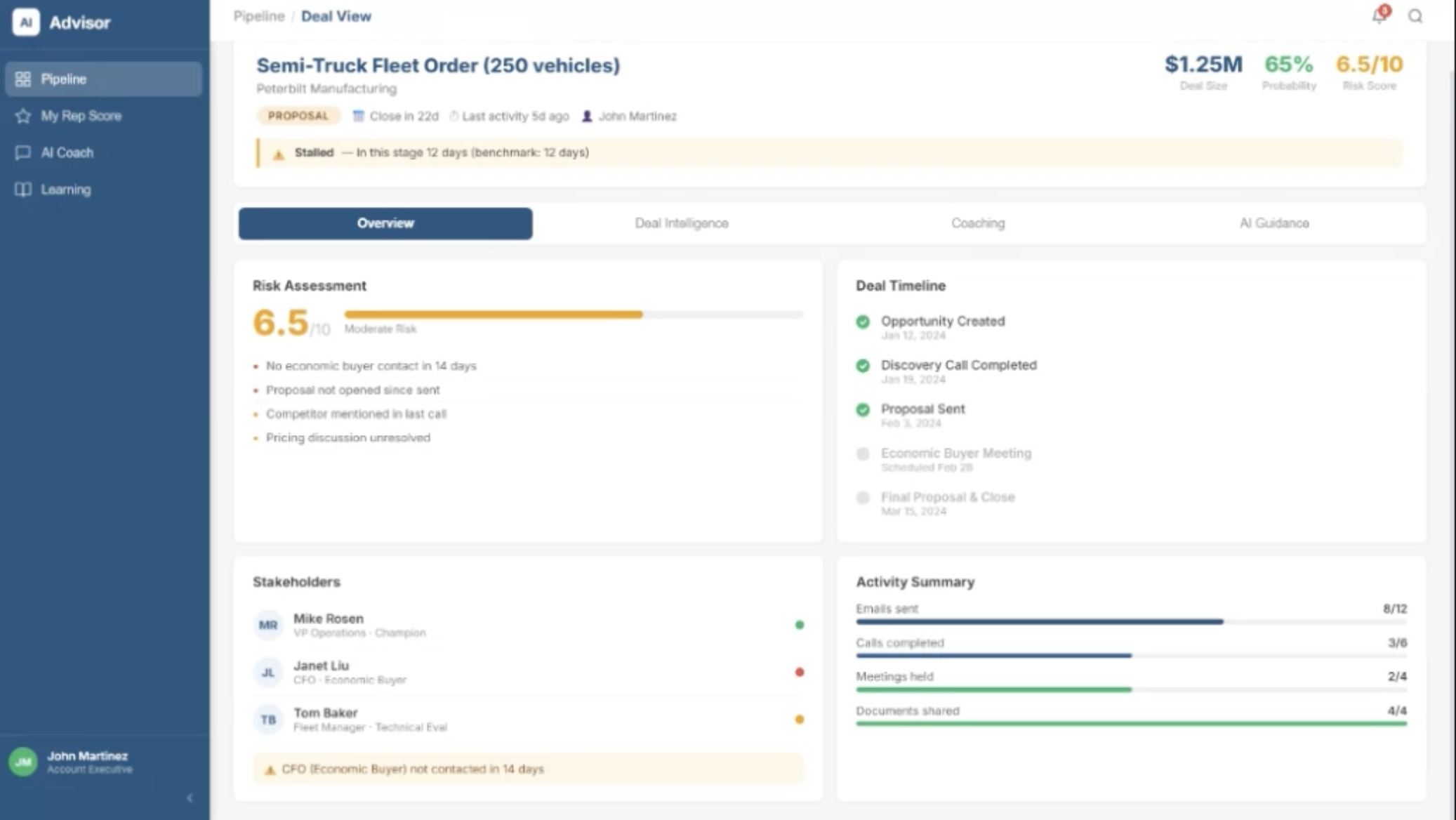
What you’re seeing here on the screen is actually a tool that Craig and I have been working on together. We call it Advisor. It works in concert with your CRM and other management tools in an organization, and it is basically an enablement tool.
What you’re looking at here, this learning tab, is a default tab which is constantly helping to look at an individual. If you’re new to an organization, you come in, and what’s happening is all of what is being presented, including your sales process and your sales curriculum, is corporate knowledge. It’s all private knowledge that gets stored and used.
It’s a private agent that’s going to collect information about all the data, whether videos, learning objects, or documents that your team needs to be successful—that tribal knowledge.
You can take advantage of every piece of data, and it will start to organize it and present it based on the user’s needs. In this case, I’ve been onboarded and started a journey, and as I interact with the content and it learns more about me from other areas of the CRM or other applications that might be important to me as a user, it’s going to make recommendations on a continuous basis in multiple ways.
This is more the traditional view of onboarding. However, as I mature in the organization, the lessons and training it delivers are dependent on my profile of how I interact with the content and how well I’m doing as a salesperson.
So let’s get back to Sales Nexus. I have a pipeline. The first thing it’s doing is showing me how well I’m doing. It’s feedback to me. These are my deals, and when I get into a deal, it’s going to start making suggestions about what I need to know in terms of technique. Where am I in the opportunity? Who am I talking to? What do I already know? I’ve already passed that course or I seem competent in that area.
But if I’m looking weak in any way, it’s going to make suggestions. Watch this video before you make this call, or consider this recording and have more empathy. It’s a coach. You’re going to be able to cycle through and get the things that you need in order to help you do your job.
It’s not meant to replace a manager. It’s meant to supplement a manager because managers have access to all of this data. But when you tell a person directly how they’re doing, they react. If I do this or learn this, I can do better. I can close more. I can close faster. They’re going to pay attention.
So here’s suggested learning based on all of this data that’s going on in my world. Then it gives me my leaderboard and my scorecard. Here’s my active improvement plan based on my KPIs, all coming between the CRM and the enablement agent working in the background.
How does the agent get to all the content? That’s up to you. That is knowledge management that you can do in the backend to feed this agent all of the knowledge that you want your people to know.
It could be videos, transcriptions, meeting recordings, white papers, documents, or the product training you’ve already built. If you’re using an LMS, it all gets entered and read. It becomes everything that the agent needs to know.
Then it starts to discover how competent the person is. They get a benchmark and move forward from there. It’s a very proactive, responsive, and agentic tool for making somebody successful.
It can be used not only for enabling, training, and coaching your salespeople, but for any role in sales, whether pre-sales or post-sales, as well as your service team.
We have financial customers where we launched prototypes a year ago that had great success. They were more interested in their upselling after somebody has been closed and teaching how to upsell better because the products were so extensive.
You can take advantage of every piece of data, and it will start to organize it and present it based on the user’s needs. In this case, I’ve been onboarded and started a journey, and as I interact with the content and it learns more about me from other areas of the CRM or other applications that might be important to me as a user, it’s going to make recommendations on a continuous basis in multiple ways.
This is more the traditional view of onboarding. However, as I mature in the organization, the lessons and training it delivers are dependent on my profile of how I interact with the content and how well I’m doing as a salesperson.
So let’s get back to SalesNexus. I have a pipeline. The first thing it’s doing is showing me how well I’m doing. It’s feedback to me. These are my deals, and when I get into a deal, it’s going to start making suggestions about what I need to know in terms of technique. Where am I in the opportunity? Who am I talking to? What do I already know? I’ve already passed that course or I seem competent in that area.
But if I’m looking weak in any way, it’s going to make suggestions. Watch this video before you make this call, or consider this recording and have more empathy. It’s a coach. You’re going to be able to cycle through and get the things that you need in order to help you do your job.
It’s not meant to replace a manager. It’s meant to supplement a manager because managers have access to all of this data. But when you tell a person directly how they’re doing, they react. If I do this or learn this, I can do better. I can close more. I can close faster. They’re going to pay attention.
So here’s suggested learning based on all of this data that’s going on in my world. Then it gives me my leaderboard and my scorecard. Here’s my active improvement plan based on my KPIs, all coming between the CRM and the enablement agent working in the background.
How does the agent get to all the content? That’s up to you. That is knowledge management that you can do in the backend to feed this agent all of the knowledge that you want your people to know.
It could be videos, transcriptions, meeting recordings, white papers, documents, or the product training you’ve already built. If you’re using an LMS, it all gets entered and read. It becomes everything that the agent needs to know.
Then it starts to discover how competent the person is. They get a benchmark and move forward from there. It’s a very proactive, responsive, and agentic tool for making somebody successful.
It can be used not only for enabling, training, and coaching your salespeople, but for any role in sales, whether pre-sales or post-sales, as well as your service team.
We have financial customers where we launched prototypes a year ago that had great success. They were more interested in their upselling after somebody has been closed and teaching how to upsell better because the products were so extensive.
Craig: I was wondering about all the knowledge. My understanding is that you can upload your stuff, and that’s part of what your system is doing here. It’s using AI to understand which white paper and which video is applicable to which situation. Is there a lot of user setup required to take advantage of something like this?
Marc: No, no. The key is implementation. That you can be trained to do it, or it can be done for you. We see a lot of people want it as a service, but once everything is in there, it’s just maintenance. It will go out and continue to read and understand. And the more that you train it on, the more it understands the context in which to use the material that you’re giving it.
So it’s a self-learning tool and it gets better and better the more you put in it and the more it analyzes things for you. So it’s not hard at all. It is easy to start out. We would make suggestions on making sure there’s consistency and understanding documents that they’re formatted in a certain way, or you can actually use transcription and transcribe knowledge into the system, meaning just talk to the machine like you’re a coach and tell it what you want it to know. We have a lot of ways to do that.
Craig: Well, kind of related to that, you brought up transcriptions. In SalesNexus, if I’m making calls and I’m doing it through my phone system that’s connected to the CRM, we’re automatically transcribing those calls. So now the advisor sees all of that. So now it’s guiding and providing suggested trainings and things like that based upon how my conversations are going.
Marc: That’s exactly right. And what we’re looking at here in this coach is a pure integration of Sales Nexus and Advisor. This is bringing the collective intelligence together and it will make suggestions based on those kinds of assets you’re creating in Nexus.
Craig: And that’s an example of what we were talking about earlier, where sometimes you have a sales rep that’s really good at sharing skills and lessons learned, and sometimes you have a team where they all keep it close to the vest. This allows you to surface that automatically. It’s proactive rather than reactive.
Marc: And the other thing that you see in the UI here is that I used to call it all roads lead to Rome. You see it makes reference in every screen to every other screen. So no matter where you are, it’s still making suggestions. Even in your pipeline and your learning, it may say focus on these things this week. But here I am again, don’t forget. This is what you should focus on this week. This is the plan we put together for you. Help me prep for my next call because it knows what your next call is because you recorded that you have a call in the CRM. So it’s very proactive and it’s trying to engage people at every step. It’s like reminders.
Craig: It seems like this, with a new sales rep, like a new BDR type person who’s going to have to learn to overcome that call reluctance for the first time, just that help me prep for my next call is valuable. Because all the anxiety that you sit there wrestling with, because you don’t know what’s going to happen in that call, to just have this system give you a little bit of knowledge and that extra push, I can’t imagine that that doesn’t cut down the ramp up time for a new sales rep tremendously.
Marc: Oh, it’s huge. It’s huge. This is a new iteration of something we’ve been doing as a service for about fifteen years with great success. The statistics are when deploying a system that does this, training continuous improvement content at the point of need, we have seen quota achievement increase by twenty eight to thirty percent across the team. This is across dozens of companies that we’ve done business with. This is a new iteration.
The excitement that I have is the partnership that you and I are doing together. I think it’s a way that cuts down the overall cost of executing a plan like this. We used to do it by hand. Now it’s automatic. We’ve got AI agents that can do what we used to do by hand automatically.
So what does that put us into, just to go back to the theme. It’s really how we bring all of this together for sales. Everboarding becomes a combination of CRM, content, training, and coaching. What I just showed you is a UI and it goes bi-directional. That UI can be delivered inside of Nexus, or you’re getting data from Nexus into the advisor. So it’s a very integrated view of how to help people move forward and make them successful.
I’d really want to hear people’s reaction to this, not because I am trying to make somebody buy something, but to show them the opportunity of how to improve things. I guarantee, and I’ve talked to the learning and development world, they are doing similar things across the board. This is not the only solution out there, but I think it’s exciting. When people step back and think about what they’re doing with their company, it’s a way to get more efficient about how you make this happen, and that efficiency will improve sales performance over time.
Craig: I have two interesting questions that came in. One is, does the advisor portal that you were showing provide guidance to the actual sales coach? It is delivering content that’s available on demand to the sales rep, but is it also giving the sales manager some things like, here are things to talk about next time you sit down with the rep?
Marc: Yes, we have a leadership dashboard as well. You can look at your team and get suggestions. You’re getting an aggregate of what the salesperson is seeing on their screens and the same suggestions. If it’s saying to the salesperson you ought to get better at writing introductory emails, that’s a signal that goes to leadership to check in. Take a look at some of their emails.
It’s a good point because don’t lose the human aspect of training and mentorship. People want reinforcement. Let’s talk about this. I noticed that you’re getting feedback on this. How can I help you? Don’t be discouraged. It’s not that the advisor is going to be mean, but if someone feels like they are not good at closing, how can I help you overcome that?
As AI begins to push on us more, it’s important to keep the human factor front and center.
Craig: The other question is, can you use this to train an AI agent?
Marc: You are training the AI agent. Would you let an AI agent go sell on your behalf? I think that’s dangerous.
What we’re doing is governing this. There are rules that the AI follows, guardrails. If the AI can make independent reactive decisions, you have a quality control issue.
Craig: The distinction that I think will not change anytime soon is if you’re selling big ticket items or even small items with repeat business, the relationship is the most valuable thing. You’re not going to automate that.
There are places where you might use an AI agent to do some outreach and open doors, but the actual sales part will have a human, and you want it to be human.
Marc: I’m more concerned about trust and accuracy. If you have a transactional sale, where someone is going to your website and you just want to answer questions, you don’t need this. There are other tools that offer bots where you just feed them and they handle that. That exists already.
Craig: It would be interesting to test it. There is an argument that you could take all of your sales content and give it to a bot, and now you have a smart sales agent that can do some things. Maybe it’s on your website as a chatbot with all that sales knowledge. But if that same bot is also learning from everything happening in the CRM and the pipeline and learning from salespeople, it could be better.
Marc: It’s a good question. I think it’s theoretical. Even with the stuff that we’re doing in the background, I don’t know how many people are familiar with vibe coding. Okay. So the vibe coding is working with, say, Claude. If people don’t know, Claude is Anthropic’s answer to AI. And you can build your own agents there.
The thing about it, it’s recursive, first of all, meaning things repeat. And they get worse as they repeat. I don’t want to get into the theoreticals of how to make AI work, but the developers that I’ve been talking to is you actually have to treat it like a human and you have to admonish it and continuously train it. As it gets smarter, it gets worse, believe it or not. So you got to keep the guardrails on it and pay constant attention to it.
And so what the developers are doing is they’re making agents to control the agents to control the agents. I’m staying out of that for the moment.
Craig: There’s some businesses where really pushing hard on that kind of thing makes a lot of sense. In most of your B-to-B situations, it’s just…
Marc: I think that relationship and if you’re selling something complex, a solution, and something that requires explanation and the process is important too. Particularly today, it’s not one decision maker, it might be five. So AI is not going to handle that well, I think.
And I think you’re going to also find, and I’m talking to executives about this, is that there’s pushback. I don’t want to be thrown into an AI engine. I want to talk to somebody.
And we all have those frustrations. I know I do, dealing with customer service. I get in a loop with bots. It’s like, you didn’t answer my question.
Craig: I think that’s the thing that’s flipped in the marketplace. Ten years ago or fifteen years ago, you started to have experiences where you were on the phone or on a website and your customer service agent that you’re dealing with, you could tell was automated. And very seldom did you ever have a great experience. It was more just okay, I get it, they’re trying to keep costs down, and as long as what I’m asking for is the same thing that everybody else always asks for, I’ll probably get what I want. But as soon as I’m asking for something that’s a little unusual, you just got to start going agent, agent, agent, so you end up talking to a person.
I think it’s flipped now in the sense that people understand why that automation is important and valuable and so on and so forth, and can be a better experience for the customer. It can be, and that’s really the distinction now. I think the marketplace has been matured in that either your AI, your chat bot, whatever you want to call it, your automation is going to yield me a better experience than I would have had with a human or not.
So better might just be faster. I didn’t have to wait on hold to talk to a human or something like that. But it better be better in some way or you’re creating a negative brand impression.
Marc: There’s no question. As I said earlier, I’m a real big proponent of human factor in everything that we recommend to any client anyway. And I think that for me, my last piece of it is AI is a tool to help humans do their job better. That’s the way I see it. And I’m happy to have a cigar smoking debate with anybody who wants to join me on that one.
Craig: There’s one question that a couple of people actually are asking. How do they try the Advisor?
Marc: Set up a meeting with us. We’ll walk you through it and we’ll get you going. We can take a small body of content and make it work for you. And so we’d be interested in understanding what your objectives are and we can put you certainly into a trial, no problem.
In the email that we’ll send out with the recording and the slides and all that good stuff, we can put in there a meeting link so they can book a time. Would love to hear from people and would love feedback as they start to use it too. This is a new release and we’re excited about it. Hope to hear from people quickly and we’ll get you piloted.
Craig: It’s really exciting. As you alluded to earlier, we’ve been talking about this for a long time, working on it for a long time. And there’s a lot more to come.
Marc: Absolutely. As we go through the series, we will be releasing and showing success stories with this on how it’s addressing each one of the titles in terms of what’s doing. So we’ve reached that point where the next one that content is not enablement. But we’ll talk more about knowledge management, whether it’s Advisor or anything else, on how to make people successful.
Craig: Just to put a finer point on that to tease everybody a little bit for next time, content is not enablement. What you’re getting at there is having the playbook and laying it on everybody’s desk, you’re not enabling anything. You got to take it a little further than that.
Marc: People may find that we’re getting repetitive, but we’re trying to drive on different points. Having the content, it’s like tree falling in the woods. If people aren’t using it, it has no value. So how do you execute that, whether it’s through tech or otherwise, to get people to embrace the content, which is important to you?
Craig: May 13, 2026 will be our next one. Everybody will get the recording and a link to register for the next event as well.