Aligning your sales process with the buyer’s journey is critical for effective selling. For this webinar, SalesNexus CEO Craig Klein is joined by Marc MacNamara of The Enablement Group.
Mark is presenting a series of webinars covering the entire arc of revenue enablement and how you can take your existing sales team and uncover the revenue that’s hiding in that process before you start hiring or re-engineering the entire business model.
Mark’s got 30 years of experience in sales enablement, consulting with B2B organizations. He’s worked with Fortune 500 companies and small businesses alike. He also has a tremendous amount of experience in sales coaching and learning enablement in the sales space. So he brings a wealth of knowledge that I know you’re all going to benefit from.
Sales process is not the buyer’s journey
Marc: My intent is always to impart as much value as I can in these sessions.
When we did the last one—and for those of you joining us again, I hope you’re returning—we spent a lot of time on the overarching elements of revenue enablement and breaking them down into key components.
Today, we’re going to dig into the core topic: sales process is not the buyer’s journey.
It’s an interesting issue I’ve seen repeatedly. At its core, it’s an alignment problem. I’d say that most organizations will fundamentally understand the difference, but the management structures and the way that we run our business often conflict with how we wanna convey that message.
And it’s often that we’re trying to drive quota achievement, which is important, but often the processes we put in place are CRM driven.
It’s: have you checked the box in the CRM to the point where. Yes, I gathered all these things and I’ve moved on to the next stage.
So today, I’m going to cover three main areas:
- Review the core problem—why the sales process is not the same as the buyer’s journey.
- Introduce the concept of MEDDICC and how it helps align those two. I’ll also provide a tool afterward that you can use to audit against MEDDICC.
- Walk through three key real-world scenarios that highlight common challenges and how to overcome them.
Sales Stages vs Buyer Decisions
So I think people can understand the core problem and I’ve seen this is that we drill into sales teams that we have steps to get through the sale. Those are indicators that we’re asking salespeople to follow.
But the real issue is that buyers have a decision journey and they don’t always match our process journey for people.
What falls down often is that we haven’t given the tools to the sales team to either recognize that and appropriately respond to it.
There’s a really good book out there and there’s various flavors of it called Others Centered Selling. Meaning putting yourself, the salesperson, putting themselves in the shoes in the mindset of the seller: how are they coming to this, how are they thinking about interacting with someone whose job it is to sell them something, but to preserve and reduce risk on their side. That’s typically part of the problem.
Sales stages track internal progress. Buyer decisions reflect risk reduction. That’s really the persona issue. And depending on who you’re talking to in the conversation, that risk could be higher or lower. And it depends on the role that you’re working with at that point.
Symptoms of Misalignment
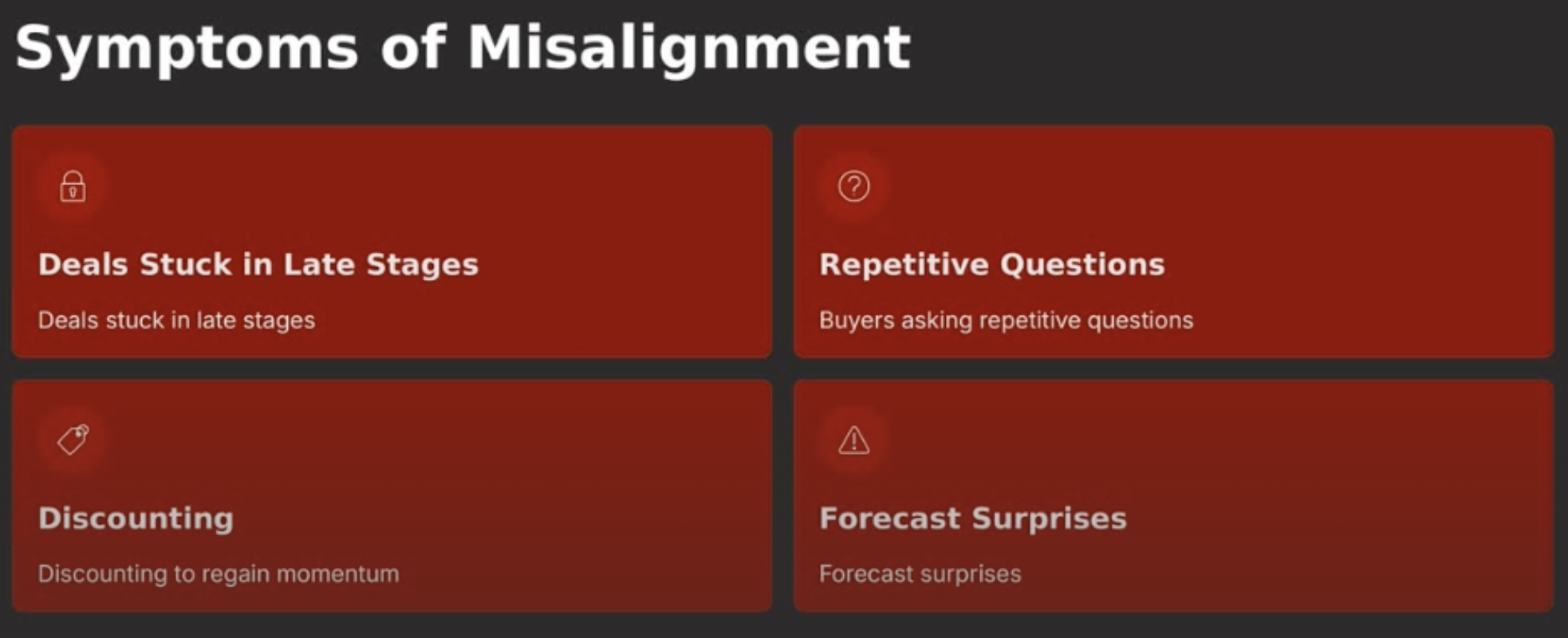
You’ll see symptoms of misalignment sometimes get stuck on other reasons.
Often sales managers will look at data and assume that things are not moving forward because of the salesperson. And it isn’t necessarily the salesperson’s fault. It might be technique or this process of understanding how to get through these blockages, right? I mean, deals get stuck in late stages. We’ve seen things, oh, it’s expected to close and it goes four quarters and it still hasn’t closed. Getting the same questions over and over again. It’s typically because we haven’t answered them well, probably, or we haven’t armed somebody to move those answers to the people who really need them.
Discounting, nobody wants to discount.
I’m not hearing that much about discounting anymore, but it used to be a continuous problem and one that went pretty deep.
And forecast surprises.
I told the story in the last session how one consulting I did with a healthcare consulting firm that missed their forecast by 80%.
I mean, that’s not something you want to do. No CFO will let you live that long if you don’t bring in the money that they’re expecting to see as a result of that, even though they tend to give it a haircut as well. So if your forecast is a hundred, they’re going to knock it down to seventy for risk. But when you miss it by 80%, that’s a tough one.
How Buyers Actually Make Decisions
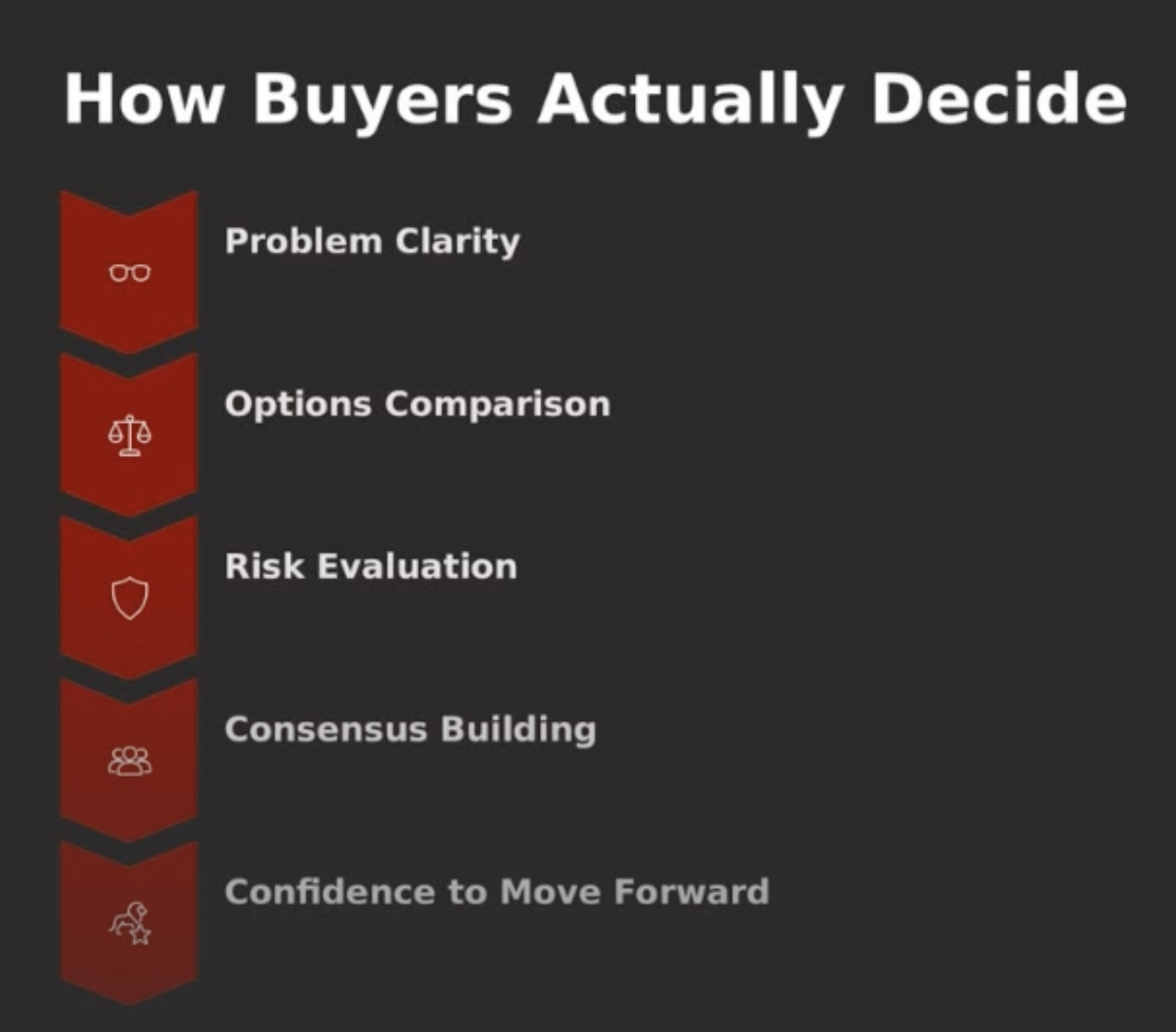
What we’re really focused on here is to really examine how buyers actually make their decisions, because that’s the key.
It’s not your process that they want to follow. They need problem clarity for themselves. They want to compare options. They’re going to do risk evaluation. They may have to build consensus in the organization and then have the confidence to move forward.
Is this a good decision?
And personalities, too, can come into that. You remember Miller Hyman training, but people make decisions differently based on their personality.
Are they ego driven? Are they operations driven, finance driven?
What makes them the hero that they need to be in the context of themselves and the organization?
This all matters because it gets in the way of efficient selling. The whole purpose of revenue and the whole purpose of sales enablement is to increase effectiveness and efficiency.
And if you’re not following the path of the buyer, you’re not going to be as efficient.
MEDDIC: A Structured Framework for Complex B2B Decision Enablement
MEDDIC: It’s a term that’s been out there a long time, but I’ve brought it back in because it’s something that I fundamentally work with a lot.
It’s an acronym and it’s a framework for helping with complex P-to-B decision enablement.
We’re going to be in agreement that the buyer’s journey is not the sales process, but the key to solving the buyer’s journey is messaging and treatment.
It’s that other centered approach to make sure we’re in full consideration of where the buyer is and what they need from us.
M – Metrics
So if we dive in, the first thing is metrics. The buyer is going to be looking for quantifiable business outcomes that they expect to achieve.
If I buy your solution, how is it valuable to me? And there’s a lot of aspects to that.
How is it measured? That’s often hard. And ROI models can be soft, particularly when benefits aren’t necessarily hard dollar metrics, but we gotta bring that to bear.
And there’s only two positions you can take when you talk about that with a customer. And we just mentioned them even for salespeople, you’re selling enablement, it’s efficiency and effectiveness.
And how do you measure that given what you’re selling somebody?
And here are examples: we reduce operating costs. We increase sales productivity. We shorten implementation cycles.
If you’re a manufacturer, our breaks last two hundred percent longer than the Chinese competition. And that’s a real story that I have from working with Federal Mogul, who makes breaks and spark plugs and all of those kinds of things.
Craig: But aren’t you saying, Mark, that if my breaks last longer, when I need to be aware that I have to translate that statement into kind of one of these categories, like that at the board level or for the CFO, they can see how it affects their balance sheet and their P&L statement, right? So the break lasts longer, which means my operating costs are gonna be lower and I can connect those two dots.
Marc: Yeah, when you’re dealing with a trucking company or something like that. Where we went, Federal Mogul, just as an aside, had a particular interesting approach because their salesperson was the mechanic in your garage. So what they had to sell was they’re going to save you money over the long term. It’s the problem that LED lights have had, and compact fluorescents had, in that – why should I pay twenty dollars for a light bulb? That’s only going to save me, you know, forty nine cents a year over the next 20 years, as opposed to an incandescent, which is a 69 cent light bulb.
So you have to put that into language, to your point, Craig, that’s going to make sense to the buyer or the person on the committee that you’re talking to at the time. And some of these things can be emotional.
E: Economic Buyer
You want to make sure that you have an individual with authority to approve budget and accept risk. A lot of times in sales process, I get somebody who goes, “Oh, I spoke to my lead and they want to buy it. And it’s going to happen.” Happy ears, I call it.
They haven’t defined whether the individual even has budget. They haven’t even considered how to go up the line.
So has that person been identified, and that’s going to be a point in your sales process that may not be at the beginning, but needs to be established at the beginning to make sure that you don’t fall down at the end.
Craig: So the economic buyer, just to be clear, is the person who has the budget approval authority?
Marc: Yes. And by the way, I just did a consult with someone who needed five approvals, not just one. So it had to go from the line manager to the district manager, to the regional manager, all the way up to the CFO. And the CFO was the final arbiter, but it needed five signatures. That’s a lot. That’s a lot to pull together. So it wasn’t just one person, it was multiple.
D: Decision Criteria
Is it compatible? Does it meet security standards? Vendor reputation? Experience, timelines… And if you do project management, you know there could be more than this.
Timelines are important from the standpoint of, OK, so one example I had was working with Hewlett Packard. We were making a recommendation with them at one point to change a piece of technology, which was going to save them considerable money if they move forward.
However, in the timeframe that they wanted to do it, it would have cost them more money, but we were able to show them by taking longer time, they were going to reduce the disruption to their employee workforce. And it actually saved them 6X what they would have spent if they tried to implement it instantly because the training program behind it would have disrupted hundreds of millions of dollars in productivity.
So we got them to spend more money as a result of a conversation of how to do it.
And the buyer at the time wasn’t thinking about the C-level conversation that had to happen in order to implement this effectively and not disrupt tens of thousands of people.
Craig: So I’m trying to make sure and picture this from a real world practical point of view.
Let’s say my brother-in-law is the economic buyer.I have an inside channel to the CFO or the COO. So he’s got the budget authority and I’m his brother-in-law so he can just make the deal. Well, not so quick. Probably he has a set of people on his team that are going to need to be consulted with with regards to each of these categories, right?
Marc: Absolutely. And this is why we don’t see singular buying behavior anymore.
It’s often committee or influencers. You have a lead, you have a champion. But in this case, the implementation piece, those were managers. You can’t do that to me.
And by the way, while it was a financial decision, it was a soft financial decision. And that goes back to metrics. How are you going to measure this? The impact was soft because it had to do with people.
Craig: The thing that always gets me about this is that it’s difficult to even guesstimate the decision maker or the economic buyer’s sort of heartburn associated with even initiating a process like this.
You may be able to show them in just unequivocal terms that you’re gonna knock five percent off of their operating budget. That seems like by itself it should be motivating enough, right?
But the guy’s got fifteen other initiatives that he signed on for at the beginning of the year and he’s got the whole team orchestrated and marching just the way he wants and now you want him to go and sort of disrupt all that progress in order to consider this new additional change in what they’re doing. And they may just say, “You know what, not now.” I just don’t have the bandwidth for this kind of complex decision-making process.
Marc: That’s right.
Decision criteria influences that economic decision. There’s no question. And oftentimes, particularly in larger organizations or even smaller ones, a lot of this hasn’t really hit people.
I think one thing I’m seeing now with the implication of AI systems, and I’m not talking about off-the-shelf ai systems i’m talking about companies that are now hiring people to implement AI,i is there they’re not necessarily considering all of the important criteria that’s going to go into a project to do that and it’s going to implement not only the economics It’s going to implement productivity. And it could even impact work output, which has cost.
All of that is part of what you, as a seller, thinking about that and messaging that appropriately will create trust.
And that’s ultimately what you want to build is trust and certainty that what you’re going to provide a customer is going to solve their problem responsibly, effectively and efficiently.
The decision process, this is often missed by a lot of sellers.
They said, “Yes!” But go back to my last point, who’s involved in this?
In many cases, you have a procurement department. In many cases, you may find yourself in the position of, they’ve made a decision, but by standards, they have to put out an RFP anyway. So you have to write the RFP if you’re going to get sale. I’ve done that a few times.
And you can see there’s all kinds of things that go into this that are going to affect your forecast, not to mention the sale itself. I mean, can’t do it this quarter. Got to do it next quarter. Actually, we don’t have any money left this year. It’s got to be next year. And a lot of companies flip in July. Their fiscal year is July one to June thirty as opposed to calendar year.
Legal reviews, contract reviews.How many of you deal with red lines? That stuff drives you crazy, right? Here’s our contract. Oh no, we’re not going to accept those terms.
So those things have to be mapped out.
What’s interesting I find is that a lot of people who are selling, they wait too long for this. And then it’s a rush to judgment. It’s a rush to get it done, when these are questions you can ask at the beginning. Ultimately, this is part of the journey.
And in fact, I’ve had buyers that don’t even know what this process is and they have to discover it. Then all of a sudden, boom, I had a client last year said, “I didn’t know we had to do this. And it extended the deal cycle by 6 months, in which everybody’s waiting. That just killed the forecast.
I: Identify Pain
Pain is an old one. Some people used to call it the FUD: fear, uncertainty, and doubt.
But I think that pain could be operational.
There’s another one I put in there: it’s, I just look bad. Things are not going well in my organization. And I’m looking, you know, I may lose my job because I haven’t solved this problem.
So there’s a lot of areas. And again, depending on the persona or the people in the room, each person may see pain differently. You have to message it differently.
Craig Klein: That’s where it really kind of gets overwhelming, right? Because every one of those different aspects that are part of the decision making process – you may have an IT guy that’s part of some of it, you got an engineer that’s part of some of it – and they all have different pains. For example, 5% savings on the operating budget, some of those guys may not care a whit about that. They’re just taking care of their own world.
Marc: No. And the work that we do to help build these modern playbooks is using the elements of MEDDICC to map out, I call it an ontological approach
You know, you’ve got categories of information, messaging, knowledge, content—all of the above—that will be used in different circumstances.
This is often the process relative to the buyer’s journey that companies have not gone through in order to have that at hand for sellers to use. That’s what I’m really trying to get people to embrace and understand.
Craig – So in other words, you’re imagining if I’m a salesperson who’s been brought in by my brother-in-law, the COO, and he’s taking me around and introducing me to all the folks that are going to be part of the decision-making process – I’ve got a different brochure or spec sheet or leave-behind for every one of those different people.
Marc: That’s correct.
Craig: Not just the same brochure going to everyone.
Marc: No. Or at least an insight or a way for you to talk to them differently.
It may not be a brochure, but you’re on the right track. Or the brochure deals with all those perspectives. There are a lot of ways to package it, but that’s exactly right.
C: Champion
When you talk about the champion, it may not be your buyer.
What a champion is, is the person who is your advocate. It’s you on the inside of the company.
If you could penetrate the company and walk around and tell your story, this is the person you need. You have to arm them and load their lips to speak the way you want them to.
That’s what makes the big sale. That’s what moves it forward.
Now, on a transactional sale, is this all necessary? No.
If you’re selling a $39.99 piece of something, this is about complex B2B sales. Just to be clear, consumer sales or individual purchases—very different.
Craig: To me the most glaring example of how the champion becomes important—
I’ve been lucky enough to have those kind of brother-in-law situations before, not literally brother-in-laws, but a customer that did business with me for a long time at another company. Now they’re taking a new role at a new company, and they bring us in: “Hey, I want you to help me at this new company.”
Well, they’ve got different people now that need to be brought up to speed and brought on board. A smart economic buyer knows this process from the organizational point of view.
They’ll take you down the hall and introduce you to somebody who’s their right hand and say: “This guy’s going to be your champion.”
In other words: I’m the COO, and you’re my friend anyway, so I want to keep it arm’s length. I’m too busy. I don’t want to get in the weeds of all this, and I don’t want to push this on my team. So I’m going to let Bob over here, who’s more of a neutral outsider, be your shepherd within the organization.
Then what you were touching on earlier – the problem you run into is, maybe I got the IT guy on board, and maybe I got the support people on board. But there’s some people in finance or some other department that just aren’t buying off on it, for any number of reasons. Might just be they have other priorities right now.
So they’re stuck. Everyone else is moving forward in my nice little sales process—they’re ready to go all the way to the end—but we’ve got this one key influencer group that isn’t moving forward.
It’s almost like every individual has their own process. It’s not just one process for the company. It’s a process for every influencer in the deal.
Marc: That’s a great way to look at it.
The persona has different aspects. When you get down to the champion, they have to deal with all of that. They’re going to have the same complicated piece.
I did a very large project where I wasn’t selling. I was coaching the champion. They were doing all the selling. Which is really what you need. At that point, you’re the deal project manager, making sure that my company gives them what they need when they need it. It was an interesting relationship because to the champion, you become a trusted advisor. You’re helping them succeed more than yourself.
They come back, and sometimes you say to them: “No, you don’t want to pursue this. I don’t see a pathway for you.” But when it’s right, they come back and work with you.
C: Competition
Last element of this is competition. Key messaging here: How do you deal with it? Be upfront about it, and know how to compare and contrast.
Look at direct and indirect competition. Probably the number one competitor is: “We don’t need this. We’re good.” The do-nothing option: “We’re good right now. Thank you.” You’ve got to deal with all of that.
Internal development—whether it’s software, hardware, or services—that can be a tough one to overcome. But typically you can show, give an expertise approach, go back to timeline issues. How long is it going to take you to get to that with your internal people? Don’t they have day jobs? Again, these AI solutions are a perfect example. You’re going to homegrow these things? Good luck.
On most of it – direct competition and adjacent solutions, because it can be indirect:
Compare, contrast, be honest.
Say: “That’s a good solution. But, Llet me explain why you might consider us over that.”
Or: “If you have this problem, that may be better.”
Don’t diss them. Position yourself. That’s really important.
That’s MEDDICC. It starts to unfold how to come at it from a messaging and process point of view that you want to start baking into your CRM.
Translating Buyer Stages – Seller Actions
I have a map that might be useful to bring up—how to think about incorporating MEDDICC and this journey into your CRM.
This will not only remind people, but make sure you’ve got the support that’ll go into it:
- content
- messaging
- insights
- questions
- competitive context
MEDDICC is buried in here, and I think you can use this as a way to align both your selling process with the buyer’s journey.
Craig: Marc was nice enough to share this with me ahead of time. So what I did is I went into SalesNexus and said, “Okay, could we create a pipeline automation system that mirrors that?”
Here’s a quick look. In fact, I asked Nexi, our AI, to do it for me. I didn’t do it manually. You can see it came up with the stages Mark had in his slide. So I can move my deals from one stage to the next the way you’re used to. But here’s the key: based on the notes I put in from Mark’s slide, it created tasks, emails, and automations at each stage. So it’s taking the seller actions Mark had and aligning them to the buyer actions in his slide.
And I think that’s the key, right, Mark? In terms of internal management, we want to keep ourselves thinking about the buyer’s process.
Marc: Yes.
Craig: But we also need to think:
Because the buyer is at that step, here’s what I should be doing. That’s all we can control at the end of the day—what we do.
So we need that mapping between the buyer decision-making process and the seller action. That’s really the key. And that’s what you would typically call the playbook.
Marc: Yeah.What’s great about this, Craig, is the ability with Nexi to bring in messaging and content into those stages, and make it relevant so you can pivot based on what’s in the CRM.
Craig: For sure. That’s one of the cool things.
But to the conversation we were having earlier –
I got five different people involved in this decision. They all have different perspectives and pain points and everything else. And so they all need to see different messages. The CTO doesn’t need to see all of the financial stuff, necessarily. He wants to see the stuff about security and compliance and things like that. He may need to see a whole drip sequence of that that takes weeks potentially, right? But the CFO does not want to see all that stuff.
So they each have to be on their own little process, which I can’t say that we’ve perfected that, because I think it’s still a little hard to get there. But you can automate it once you figure it out – once you know what you want to do, you can automate it in SalesNexus.
Marc: Well, all I got to say is, that’s why we consultants are still around.
Craig: Yeah. Because it’s hard. It’s hard to do it, especially on yourself.
I can do it on you and you can do it on me and so on and so forth. But for me to do it on me is really hard to just be objective.
Marc: What I have here are 3 buckets.
They’re just examples of things that I’ve seen and turning them into some takeaways that you can use, and they seem to create ahas for people, particularly when you observe your salespeople, listen to recordings, their calls.
I don’t know how many people record their SDRs or even their sales folks when they’re on the phone, but that is their natural behavior. And one of the things you find by listening to how they respond to people once they’re talking to them really tells you how they’re running through your process, delivering messaging.
And even roleplaying will help you get to that if you’re not doing that today.
Common Sales Misstep: Starting Too Early
So the first one is, where do we often start with a buyer? And we often start with a misstep.
I mean, we’re exploring options. Oh, I got somebody. But they may not want to hear what you have yet. Again, put yourself in their mind. That’s an early stage, and sellers will misread that. They’re not ready for a solution conversation.
What they’re ready for is a problem conversation and an understanding from you, the seller, that you understand that problem and consider what their pain points are. That’s an important distinction.
We see a lot of reps, “Let’s schedule a demo.” They don’t want to see a demo. They know what your software does potentially, or they know what you produce, what your services are.
We know that given the web and all that we’ve done and now with AI – “Hey, ChatGPT, find me four companies that do this”. So now I’m contacting you or filling out a contact form, and I’m exploring.
So it’s not about technical product information. It’s about framing their issues. That’ll fail because it doesn’t recognize that you’re thinking like them. You’re not putting yourself in their shoes and recognizing their decision-making process.
So they’re probably at a problem validation.
Do I have this problem? Do I actually need this type of thing? Is what I’m doing so bad? It’s related to the old sunk cost thing. Some people you got to show them that it’s a sunk cost problem. What you spent today has nothing to do with what you spend going forward.
It’s classic: “I’ve already spent 150,000, so I’m not going to spend any more.” Yeah, but how much is it costing you every month to do the same thing over and over again, when you could save money in the long run.
Recommended Seller Actions
So actions to take:
- validate their hesitation
- reframe it to a financial impact
- invite collaboration
Don’t control the process— collaborate on the process. They’ll appreciate that.
Buyers don’t want to feel rushed. And they want to know that you hear them overall.
Validating Buyer Hesitation Technique
Craig: The most powerful sales technique I know of is what you’re saying here – validate the buyer hesitation.
I learned that technique as the takeaway. We’ve talked about the solution and your specific needs and the financial benefits and so on and so forth, and then some version of:
“But I know you guys already have your annual strategic plan and you’re well into it, and it seems like it’s going well, and you’ve got a lot on your plate. I know you don’t have a lot of time and your organization’s already running at full speed. You probably don’t have the bandwidth to take on this kind of project even though it may save you 10% on your operating costs.”
And that gives the buyer the opportunity to vent and tell you about all the reasons they’re hesitating or not ready to jump forward.
And that way, now you know where you stand and what the obstacles are so you can start trying to knock them down.
Marc: Exactly. Again, messaging here— we often look at sellers as understanding how to sell, but there’s technique, and that’s the hardest thing to teach.
So the package of materials you’re going to create to enable them is going to be important.
So recognizing— and again repeating:
Old behavior advance the stage
New behavior advance the decision
That’s a real different mindset. It could be a management mindset – I need to get to this step of the sale so that the forecast is moving forward.
But in the checklist— have you advanced the decision? Have you met the criteria of the buyer to move forward with the next step of their journey.
MEDDICC Alignment
Again, you’ll see this in your audits that I’m going to help with our workbook.
Assuming that one step or one piece of MEDDICC is enough— but it’s not. You have to look at the entire MEDDIC profile and make sure you’ve got all the boxes checked.
They don’t necessarily have to go in order, but in this example— “I got a champion, I’m all set.” No, not necessarily.
What’s the buying process? What’s the criteria? How does it all come together into that entire journey that’s important to the prospect or the customer?
And all of these, by not doing them well, will cause stall or even no sale at all because you haven’t really dealt with it.
A champion is good, but they’re going to have the same problems you have going through this.
And your job is to be able to help them go through the people that they’re going to be working with in their journey in terms of making a decision.
They have risk too. They can get egg on their face. So it all comes together in a meaningful way.
Looking at managers managing this process is to keep reminding them of what needs to be done.
So how do you enable sales?
It comes down to content and coaching and knowledge.
MEDDICC as we talked about, is not a CRM checklist. It’s a support framework for the buyer, in making sure you get everything you need to build a consensus and take them through the entire journey that they have to make that decision.
Content, Coaching, and Execution
And the last— it comes down to content and coaching.
We’re back to the enablement piece. We’re not often doing what needs to be done even though we may understand what to do.
We’ve got to put it in the hands of sales, and teach them, give them the skills and give them the support material that lets them go through this.
And again, I think the MEDDICC audit would help a lot.
Can you ask the potential buyer what would solve their problems if they know?
They may not even know. Sometimes you have to have a questioning strategy that points out their problems. They may not understand that.
Craig: You got to think like a doctor.
It happens to me all the time. You go into a doctor thinking you already know what the problem is and you want a certain prescription. And the doctor’s never that easy in my experience. They always are going to back you up and go, “Tell me what’s happening. What are you experiencing? What symptoms are you seeing?” And they’re going to push in different directions than you’re already thinking just to be sure they’re seeing the big picture.
So you have to take that approach as a salesperson.
Because the customer may— sometimes this whole system can play out where the customer actually reached out to you originally, thought they had a specific problem, and you might have a solution to that very specific problem.
But just following their momentum, you’re going to end up selling them a $5,000 part. But if you back up and really say, “What are you doing with this thing and what’s the real problem and what does this part facilitate in your overall organization?”
Next thing you know, you’ve got a $50,000 opportunity.
Marc: There are things back to enablement that aligned content will help your salespeople get through this.
It’s roadmaps, case studies, risk mitigation plans, and timelines with milestones.
All relative to how to think about that journey and instill it in your seller’s mindset to help them move forward.
It’s not easy. I feel like I’ve probably thrown out a lot of stuff here today, which may have seemed a little erratic, but trying to give you as much information to start your thought process.
I’m available if anybody wants to talk post-session or answer questions via email.
In some organizations this takes a long time to do. It gets more complicated the more people you are onboarding and how frequently you’re onboarding them. And their age. Young sellers in particular are not well aligned to this process and need to be shown. They’re often just the hammer looking for the nail.
Craig: This kind of selling is something that some people were lucky enough early in their career to get training, where they got some sort of instruction in this direction.
But most of us learned it the hard way. We got out there and tried to close every deal. Every time we shook a hand, that was a deal about to be closed.
And then you learn because you experience the problems – deals you think are closing just ghost you. They won’t say no, but they never buy. It goes on for months and months, and you’re trying to figure out what you’re doing wrong. And it’s only when you start to understand these concepts that you realize you’re oversimplifying this whole thing.
Marc: Now we’re moving from old enablement models to new enablement models.
We’ll continue to talk about how to naturalize this through our series, and it in itself is a journey.
In each presentation we’ll review what we’ve talked about and build on it.
I hope this was useful and hope to see you in the next session.